Scholarship Options for Indian Students 2026-27: Complete Guide to NSP, State & Study Abroad Funding
By UniPortal Editorial Team
Money should never decide who gets to study. Yet for lakhs of Indian students every year, tuition fees and living costs are the biggest barrier to a degree.
The good news is that India runs one of the largest scholarship systems in the world. Central schemes, state portals, college funds, private trusts, and foreign government programs together support millions of students each year.
This guide covers every major scholarship option for Indian students in 2026-27. You will learn what each scheme offers, who qualifies, and how to apply without mistakes that cause rejection.
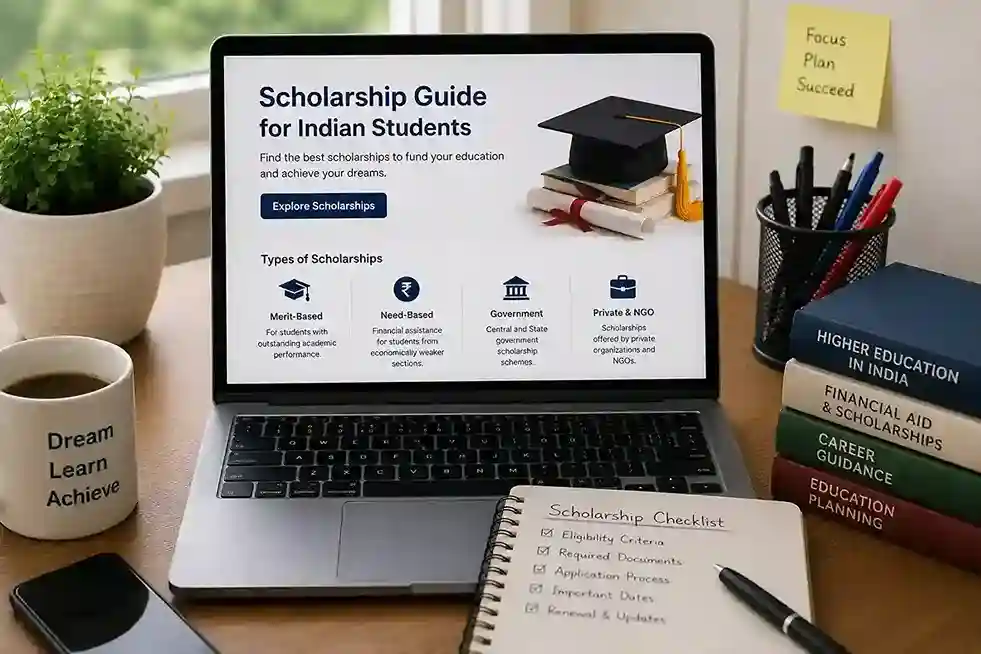
Types of Scholarships Available in India
Most scholarships in India fall under four broad groups. Knowing which group fits you saves time and avoids wasted applications.
Central Government
Funded by the Ministry of Education, AICTE, UGC, and other central bodies. Applied through the National Scholarship Portal. Covers schemes like AICTE Pragati, Post-Matric SC/ST, and Central Sector Scholarship.
State Government
Run by individual states through their own portals, such as Digital Gujarat, MahaDBT, and the UP Scholarship Portal. Open only to domicile residents of that state.
Institution Scholarships
Offered directly by colleges. IITs and NITs give Merit-cum-Means awards and fee waivers for SC, ST, and economically weaker students enrolled at that institute.
Private and Corporate
Funded by trusts and companies, such as Tata Trust, Reliance Foundation, and Infosys Foundation. Usually merit-based, with some reserved for women or specific fields.
Different Scholarship Options for Indian Students
Beyond the four broad groups, here is a practical breakdown of every scholarship option open to Indian students right now.
Government scholarships for school students: Pre-Matric and Post-Matric schemes for Class 1 to 12. Aimed at SC, ST, OBC, and minority students from low-income families.
Government scholarships for college students: Merit-cum-Means, Central Sector Scholarship, and technical education schemes for undergraduates and postgraduates.
State-specific scholarships: Each state runs its own funding for residents, often with higher amounts than central schemes for the same category.
Institution-based aid: Fee waivers and stipends given directly by the college a student is already enrolled in.
Private trust and corporate funding: Awards from foundations and companies, often need-based or focused on a specific field like engineering, medicine, or the arts.
Study abroad scholarships: Indian government schemes like the National Overseas Scholarship, plus foreign government and university funding for studying outside India.
You can browse live listings by category on our scholarships page, updated for the 2026-27 cycle.
How to Apply on the National Scholarship Portal
The National Scholarship Portal, scholarships.gov.in, is the single window for central government scholarships. It opened for the 2026-27 session on June 1, 2026. The last date for most fresh applications is October 31, 2026. Here is how to apply.
1
Complete One Time Registration (OTR): Visit scholarships.gov.in and register using your Aadhaar number and mobile OTP. OTR gives you a 14-digit ID valid for your entire academic career, so you never register again.
2
Log in and pick one scheme: Use your OTR ID to log in, then choose the single scholarship scheme that matches your class, category, and income. NSP allows only one central scheme per student per year.
3
Fill in your application: Add personal details, academic marks, and bank details. Include parent income and institute details exactly as they appear on your records.
4
Upload your documents: Photo, signature, income certificate, caste or category certificate, last marksheet, bonafide certificate, and bank passbook copy.
5
Submit and track status: After submission, your form moves through institute verification, then district and state checks. Funds reach your account through Direct Benefit Transfer once approved.
Renewal students do not register again. Log in with your existing OTR ID and apply for renewal in the same window.
Top Central Government Scholarships
These are the most-used central schemes on NSP for 2026-27. Check exact amounts on the portal, since they change each cycle.
AICTE Pragati Scholarship: For girl students in AICTE-approved technical courses like engineering, pharmacy, and architecture. Family income must be under 8 lakh rupees a year.
AICTE Saksham Scholarship: For students with disabilities in technical diploma and degree courses, with similar income limits as Pragati.
Central Sector Scholarship Scheme: For meritorious students from any category who scored above the 80th percentile in Class 12. Family income must stay under 8 lakh rupees.
Post-Matric Scholarship for SC and ST students: Covers tuition fees, maintenance allowance, and other charges for students from Class 11 to PhD level.
National Means-cum-Merit Scholarship (NMMS): For Class 9 to 12 students from low-income government school families who clear a state-level selection test.
Pre and Post-Matric Minority Scholarships: For students from Muslim, Christian, Sikh, Buddhist, Jain, and Parsi communities, based on income and academic eligibility.
National Overseas Scholarship (NOS): For SC, ST, and other marginalised students admitted to a top global university for a master's or PhD. Covers tuition, travel, and living costs.
State Government Scholarship Schemes
Every state runs its own portal for residents. State scholarships often pay more than central schemes for the same category, so always check your home state first.
Digital Gujarat Scholarship Portal: Covers Gujarat residents from school to postgraduate level, including SC, ST, OBC, EWS, and minority categories.
MahaDBT (Maharashtra): A single portal for all Maharashtra state scholarships, fee waivers, and Direct Benefit Transfer schemes.
UP Scholarship Portal: Handles pre-matric and post-matric scholarships for Uttar Pradesh students across all categories.
ePASS (Telangana and Andhra Pradesh): Covers tuition fee reimbursement and maintenance allowance for eligible students in both states.
e-Kalyan (Bihar) and SJE Rajasthan: State welfare department portals for SC, ST, OBC, and minority students in Bihar and Rajasthan.
Karnataka and Tamil Nadu e-Kalyana portals: Provide post-matric scholarships and hostel support for students from reserved categories in each state.
Most state portals need a domicile certificate as proof of residency, which central scholarships do not require.
Private and Institution Scholarships
Private and institution funding often skips strict income rules. This makes it a useful backup option.
IIT and NIT Merit-cum-Means Scholarship: Covers tuition fees and a monthly stipend for students already enrolled, based on family income and academic standing.
JN Tata Endowment: Offers interest-free or low-interest loan scholarships for postgraduate study, including study abroad.
Reliance Foundation Undergraduate Scholarship: A large merit-based program supporting thousands of undergraduate students each year across India.
Narotam Sekhsaria Foundation and Inlaks Scholarships: Support high-achieving students with leadership potential, often for postgraduate study in India or abroad.
Aga Khan Foundation and KC Mahindra Education Trust: Offer loan scholarships and grants for students who show financial need alongside strong academic records.
Studying overseas does not have to mean unlimited debt. These programs fund tuition, travel, and living costs for Indian students abroad.
National Overseas Scholarship: The Indian government's own scheme for SC, ST, and denotified tribe students. Covers tuition, airfare, and a living allowance for top-ranked global universities.
Fulbright-Nehru Master's and Doctoral Fellowships: Funded jointly by the US and Indian governments for graduate study at US universities, with leadership and merit criteria.
Chevening Scholarships: A UK government program covering a one-year master's degree, including tuition, living costs, and flights.
Commonwealth Scholarships: For master's and PhD study in the UK, scored on academic merit, proposal quality, and development impact.
DAAD Scholarships (Germany): Fund postgraduate study and research in Germany, with EPOS awards needing two years of work experience.
MEXT Scholarship (Japan): Covers tuition and a monthly stipend for undergraduate, master's, and doctoral study in Japan.
Erasmus Mundus and Maitri Scholarship (Australia): Erasmus Mundus funds joint master's programs across Europe, while Maitri supports STEM study in Australia.
University-specific aid: Top universities such as Yale, Stanford, and Melbourne offer their own need-based and merit-based grants to admitted international students.
Most study abroad scholarships need English scores like IELTS or TOEFL. Graduate programs may also ask for GRE or GMAT scores. Start applications 12 to 18 months before your intended intake.
Documents You Will Need
Keep these ready before you start any application, government or private.
Aadhaar card and an Aadhaar-linked bank account in the student's name
Income certificate issued in the current financial year
Caste, category, or minority certificate, where the scheme requires it
Domicile certificate, for state scholarships
Last academic year marksheet and a bonafide or enrollment certificate
Passport-size photo and signature scan, for online upload
Passport and English test scores, for study abroad applications
Tips to Ensure Your Scholarship Application is Approved
✔
Link your bank account to Aadhaar: Direct Benefit Transfer fails without this link. Open a new account in your name if your existing one is not linked.
✔
Apply in the first two weeks: NSP servers slow down close to deadlines. Apply early to avoid last-minute technical errors.
✔
Confirm your institute is registered: If your college is not listed on NSP, ask the institute nodal officer to register it before you apply.
✔
Use a fresh income certificate: Certificates issued before April 1 of the current financial year are usually rejected. Get a new one from your Tahsildar or SDM office each year.
✔
Apply to only one central scheme: NSP allows one central scholarship per student each year. A second application leads to rejection of both.
✔
Match names exactly: Your name and date of birth on the application must match your Aadhaar card, character by character.
How to Choose the Right Scholarship
Start with the scheme you can actually qualify for. Skip chasing the highest amount first.
Check your category first. SC, ST, OBC, and minority students usually qualify for more government schemes than general category applicants. Next, check your family income against each scheme's limit, since this single number disqualifies more applicants than any other factor.
If you study at an IIT, NIT, or a large private university, check its own scholarship office first. Many students miss funding sitting inside their own college.
For study abroad plans, match your course level to the right scheme. Undergraduate students should look at university-specific aid. Postgraduate and PhD students have far more government and foreign funding to choose from. Our MBA admissions guide and JEE preparation guide cover course-specific planning in more detail.
Frequently Asked Questions
What are the different scholarship options for Indian students?+
Indian students can choose from central scholarships through NSP, state scholarships, institution funding from IITs and NITs, private trusts, and study abroad options like the National Overseas Scholarship, Chevening, Fulbright-Nehru, and Commonwealth. Each option has its own eligibility rules and income limits.
What is the last date for NSP scholarship 2026-27?+
The NSP portal opened on June 1, 2026 for the 2026-27 academic session. The last date for fresh applications under most central schemes is October 31, 2026. Dates vary by scheme, so check the official portal for confirmation.
Can I apply for both state and central scholarship?+
Yes. You can apply for one central government scholarship through NSP and one state government scholarship at the same time. You cannot apply for two central schemes in the same year, since this leads to rejection of both applications.
What if my scholarship application is rejected?+
Common rejection reasons include an outdated income certificate, a bank account not linked to Aadhaar, an unverified institute, or selecting the wrong scheme. Fix the issue and reapply if the window is open, or apply again during the next renewal cycle.
Do Indian students need IELTS or GRE for study abroad scholarships?+
Most study abroad scholarships need an English proficiency score like IELTS or TOEFL. Programs for graduate study, such as Fulbright-Nehru, may also need GRE or GMAT scores depending on the course and university.
Can students get a scholarship without a domicile certificate?+
State scholarships almost always need a domicile certificate to prove residency. Central scholarships through NSP and most private trust scholarships do not need one, since eligibility depends on income, category, or merit instead.
E
Written by UniPortal Editorial Team
Reviewed and verified by the UniPortal India editorial team using official NSP, AICTE, and UGC notifications.