MBBS Admission in India: Overview
Getting into a medical college in India starts with one exam. NEET UG is the only entrance test for MBBS admission in India. Every medical college follows this rule, whether it is government or private. AIIMS and JIPMER also select students through NEET UG, not through separate tests.
India has more than 1.29 lakh MBBS seats across roughly 824 medical colleges. Government colleges hold about 63,500 of these seats. Private and deemed universities hold the rest.
This medical admissions guide for Indian students covers everything you need for 2026. You will learn NEET UG eligibility, the exam pattern, and cutoff trends. You will also learn the counselling process and fee structures at every college type. We start with this year's biggest update: the NEET UG re-exam.
NEET UG 2026 Re-Exam: What Changed
NTA conducted the original NEET UG 2026 exam on May 3, 2026. On May 12, 2026, NTA cancelled this exam. Investigators found evidence of a coordinated question paper leak. A "guess paper" matched large parts of the actual exam, especially in Biology.
The government referred the case to the CBI. The CBI registered a case for cheating, criminal conspiracy, and destruction of evidence. Investigators have made multiple arrests connected to the leak.
NTA then confirmed June 21, 2026, as the Re-NEET exam date. Students did not need to register again. NTA refunded the original exam fee and issued fresh admit cards. The re-exam followed the same pattern as the cancelled paper: 180 compulsory questions worth 720 marks, conducted offline.
This delay has pushed the entire admission calendar back. NTA is expected to declare the NEET UG 2026 result in July 2026. MCC and state counselling will likely start later than in past years. Keep checking the official NTA website for the confirmed schedule. Avoid relying on social media rumours during this period. If you are still revising, our NEET preparation guide can help you use the extra weeks well.
NEET UG Eligibility Criteria
Specific rules decide who can sit for NEET UG and apply for MBBS admission in India.
- Academic qualification: Pass Class 12 with Physics, Chemistry, and Biology or Biotechnology.
- Minimum marks: 50% aggregate in these subjects for General category; 40% for SC, ST, and OBC; 45% for General-PwBD.
- Minimum age: At least 17 years old by December 31, 2026.
- Upper age limit: None. The Supreme Court removed this cap in 2018.
- Number of attempts: No limit on how many times you can take NEET UG.
- Nationality: Indian citizens, NRIs, OCIs, and foreign nationals can all apply, subject to separate quota rules during counselling.
Keep your Class 10 and Class 12 certificates ready well before registration. You will need them again at every stage of counselling, right up to final admission.
NEET UG 2026 Exam Pattern
NEET UG tests three subjects: Physics, Chemistry, and Biology. Biology splits into Botany and Zoology.
The paper has 180 compulsory questions, with no optional section. Physics carries 45 questions for 180 marks. Chemistry carries 45 questions for 180 marks. Biology carries 90 questions for 360 marks. Total marks stand at 720.
Each correct answer earns 4 marks. Each wrong answer costs 1 mark. An unattempted question earns zero marks, with no penalty.
The exam runs for 3 hours in offline, pen-and-paper mode, using OMR answer sheets. Candidates can choose from 13 languages, including Hindi, Bengali, Tamil, and Gujarati. Biology carries the highest weight in the paper. Strong NCERT preparation in Botany and Zoology lifts your score the most.
NEET Cutoff: Qualifying vs Admission Marks
Many students confuse two different cutoffs. The qualifying cutoff only lets you sit for counselling. The admission cutoff decides whether you actually get a seat.
The qualifying percentile stays fixed each year. It is the 50th percentile for General and EWS candidates. It is the 40th percentile for OBC, SC, and ST candidates, and the 45th percentile for General-PwBD candidates. In 2025, General and EWS candidates qualified between 144 and 686 marks. OBC, SC, and ST candidates qualified between 113 and 143 marks. These numbers shift slightly each year based on exam difficulty and total applicants.
Clearing the qualifying cutoff does not guarantee a seat. Government college admission needs a far higher score. The table below shows realistic score ranges based on past years' trends, not the official 2026 result.
| College Type | Approx. Score Needed (General) | Approx. Rank | Annual Fee Range |
|---|---|---|---|
| AIIMS Delhi / JIPMER | 680–720 | Top 1–200 | Under ₹5,000 |
| Top State Govt. College | 600–650 | Top 500–10,000 | ₹30,000–1.5 lakh |
| Average Govt. College | 500–600 | Top 10,000–50,000 | ₹50,000–2 lakh |
| Private Deemed (Top Tier) | 450–530 | Up to 1.5 lakh | ₹10–25 lakh/year |
| Private / NRI Quota | 400 and above | Beyond 1.5 lakh | ₹15–40 lakh total |
NTA and MCC will publish the official NEET UG 2026 cutoff and rank list only after the result. Treat the figures above as planning guides, not guarantees.
MBBS Seats in India: Government vs Private
MBBS seats in India fall into clear categories. Knowing each type helps you build a realistic counselling strategy.
Government medical colleges are run by state or central governments. This group includes AIIMS, JIPMER, and state government colleges. Fees stay low, but competition is intense. Private medical colleges are privately managed, with fees running far higher than government colleges. Deemed universities are autonomous institutions that join central counselling, often with fees close to top private colleges.
As of 2026, National Medical Commission data shows roughly 63,500 government seats and around 66,000 private and deemed seats nationwide. Karnataka, Maharashtra, Tamil Nadu, and Uttar Pradesh hold the largest seat shares among states.
Seats also split by quota. All India Quota (AIQ) covers 15% of government college seats, plus 100% of seats in AIIMS, JIPMER, and central universities. MCC manages AIQ counselling for candidates from any state. State Quota covers the remaining 85% of government seats, managed by each state for its own residents.
Check our college rankings page for college-wise data before you finalise your choice list for counselling.
Top Medical Colleges Accepting NEET UG
Some institutions consistently draw the highest NEET UG ranks every year. Knowing this list helps you set realistic targets during choice filling.
- All India Institute of Medical Sciences (AIIMS), New Delhi
- JIPMER, Puducherry
- Maulana Azad Medical College, Delhi
- Christian Medical College, Vellore
- Armed Forces Medical College, Pune
- King George's Medical University, Lucknow
- Banaras Hindu University Institute of Medical Sciences, Varanasi
- Grant Government Medical College, Mumbai
- Madras Medical College, Chennai
- Kasturba Medical College, Manipal
Government colleges on this list need very high AIQ or state quota ranks. Private and deemed colleges in this group accept a wider rank range, but at a higher fee. Manipal and Vellore, for example, run large self-financing quotas. Always confirm current NMC recognition before you add any college to your final list.
Reservation Policy: SC, ST, OBC, EWS, PwBD
For the 15% AIQ seats, the central government applies fixed reservation percentages across the country. SC candidates get 15%, ST candidates get 7.5%, OBC-NCL candidates get 27%, and EWS candidates get 10%. PwBD candidates get a 5% horizontal reservation that applies within every category, including the unreserved pool.
These percentages apply uniformly to AIIMS, JIPMER, central universities, and the AIQ share surrendered by every state college.
EWS eligibility needs an annual family income below ₹8 lakh. The family must also not own large farmland or large residential property, as defined in the official EWS guidelines.
State Quota seats follow separate rules set by each state government. Reservation percentages, domicile conditions, and document formats can differ sharply from one state to the next. Always check your own state's official counselling brochure before relying on any general figure.
NRI, OCI and Foreign National Admission
NRI, OCI, and foreign national students can also apply for MBBS admission in India through NEET UG. They follow the same exam and the same minimum eligibility rules as Indian residents.
Most private and deemed colleges keep a separate NRI quota with a fixed number of seats. These seats carry much higher fees, often quoted in US dollars or a fixed lakh range per year.
NRI quota admission usually needs extra documents. This can include an NRI sponsorship certificate, passport copies, and proof of the candidate's relationship with the sponsor. Foreign nationals must submit valid citizenship proof, such as a passport copy or an embassy certificate.
Indian students who plan to study MBBS abroad must also clear NEET UG first. Without a valid NEET UG score, they cannot sit for India's medical licensing exam later.
MCC NEET Counselling: Step by Step
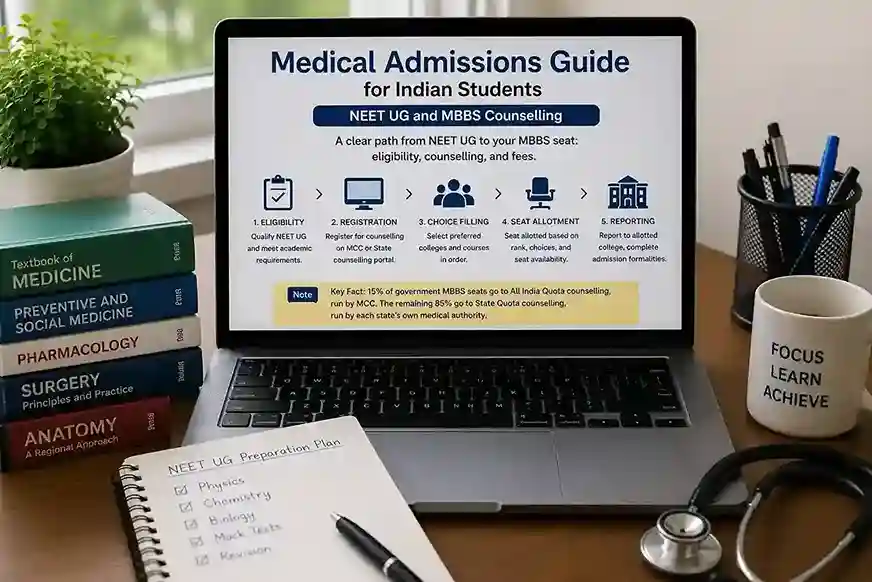
The Medical Counselling Committee (MCC) runs NEET UG counselling for All India Quota seats. This covers 15% of government college seats, plus 100% of seats in AIIMS, JIPMER, ESIC, and central universities.
- Register on mcc.nic.in once NTA declares the NEET UG result.
- Fill your choices: list colleges and courses in order of real preference, up to 200 or more.
- Lock your final choice list before the deadline. Unlocked lists may not be considered.
- Check Round 1 seat allotment, based on your rank, category, and choices.
- Accept the allotted seat, pay the security fee, and report to the college with original documents.
- Wait for Round 2 or stray vacancy rounds if you want to try for a better seat.
State Quota counselling runs separately, alongside MCC counselling. You must register with your own state's medical counselling authority too, not just MCC. Fill choices in both processes at the same time. A state government seat with a lower fee often beats a costly private seat. Plan your list around your real rank, not your dream college alone. For exam-date tracking and official notices, bookmark the NEET UG exam page.
Documents Required for Counselling
Keep these documents ready in original form, plus two photocopy sets, for every counselling round:
- NEET UG admit card and final scorecard
- Class 10 and Class 12 marksheets and passing certificates
- Birth certificate or any valid age proof
- Passport-size photographs, matching your NEET UG registration photo
- Category certificate (SC, ST, OBC-NCL, or EWS), where applicable
- PwBD certificate, if claiming disability reservation
- Domicile or residence certificate, for State Quota seats
- Valid government photo ID, such as Aadhaar or passport
- Migration certificate and transfer certificate, if your state requires them
Colleges reject incomplete document sets on the spot, so double-check this list before every reporting date. If you need help reviewing your paperwork, our team offers free guidance through the admissions support page.
MBBS Fees: Government vs Private Colleges
MBBS fees vary sharply by college type, and this is often the deciding factor for many families.
| College Category | Annual Fee Range | Approx. 5.5-Year Total |
|---|---|---|
| AIIMS (Central Govt.) | ₹1,600–₹5,000 | Under ₹25,000 |
| State Govt. Medical Colleges | ₹30,000–₹1.5 lakh | ₹1.5–8 lakh |
| Central Universities (BHU, AMU) | ₹20,000–₹80,000 | ₹1–4 lakh |
| Private Aided Colleges | ₹2–5 lakh | ₹10–27 lakh |
| Private Unaided / Deemed | ₹8–25 lakh | ₹40 lakh–1.4 crore |
| NRI Quota (Private) | ₹15–40 lakh | ₹80 lakh–2.2 crore |
NMC guidelines direct private colleges to charge government-level fees for 50% of their seats. In practice, several private colleges have challenged this rule in court. Actual fees still vary by state and college as a result. Always confirm the exact fee breakup in writing before you accept any seat.
Government colleges also offer hostel and mess facilities at low cost. Private colleges often add separate hostel, library, and development charges on top of tuition. If fees are a major concern, explore our scholarship guide for medical students before counselling begins.
Government or Private MBBS: How to Decide
Let your NEET UG rank guide this decision, not personal preference alone.
- Top 10,000 rank: Aim for AIIMS, JIPMER, or a top state government college.
- 10,000 to 1,00,000 rank: Target state government colleges through State Quota, with a few reputed private or deemed options as backup.
- Beyond 1,00,000 rank: Private or deemed colleges become your realistic path. Some students at this stage also look into MBBS abroad as a backup. NEET UG stays compulsory either way.
Before accepting any private seat, confirm its NMC recognition. Check the NAAC grade and hospital bed strength too. Review the bond policy and any hidden charges as well. A government seat usually costs less and carries strong brand value. A private seat can offer more flexibility and modern infrastructure. Choose based on your budget, your rank, and your long-term career goals, not on advertising alone.
MBBS Course Duration and Curriculum
MBBS in India runs for 5.5 years in total. This includes 4.5 years of academic study, followed by a 1-year compulsory rotatory internship. The academic years split into pre-clinical, para-clinical, and clinical phases.
NMC requires at least 75% attendance in theory classes and 80% attendance in practical and clinical postings. Missing this threshold can stop you from sitting university exams, regardless of your marks.
After the internship, you register with your state medical council to start practising. Most students then either begin work or prepare for NEET PG to pursue an MD, MS, or diploma course.
Common Mistakes to Avoid
- Skipping State Quota registration because you already registered with MCC. Register for both.
- Filling too few choices during choice filling. List every college you would genuinely accept.
- Missing the choice-locking deadline. An unlocked list may not be considered for allotment.
- Ignoring document verification rules. One missing certificate can cancel an allotted seat.
- Trusting unofficial agents for "guaranteed" seats. No agent can bypass NEET UG or counselling rules.
- Choosing a college by fee alone, without checking NMC recognition and hospital strength.
- Missing the reporting deadline after seat allotment, which can forfeit the seat entirely.
Avoid these errors, and your counselling experience will run far smoother. This guide will keep updating as NTA, MCC, and NMC release fresh notices through 2026.