What Is NEET and Why It Matters
NEET UG is India's only national-level entrance exam for undergraduate medical admissions. It is the gateway to MBBS, BDS, BAMS, BHMS, BUMS, and other allied health courses across all government and private medical colleges in India. This includes top institutions like AIIMS Delhi, JIPMER Puducherry, and all state medical colleges.
Every year, over 20 lakh students register for NEET. Only a fraction secures seats in government medical colleges. This makes smart, structured preparation non-negotiable for every serious aspirant.
The National Testing Agency (NTA) conducts NEET under guidelines from the National Medical Commission (NMC). The exam is held annually, usually in the first week of May. For NEET 2026-27 aspirants, this guide covers everything you need to plan and execute your preparation from Day 1.
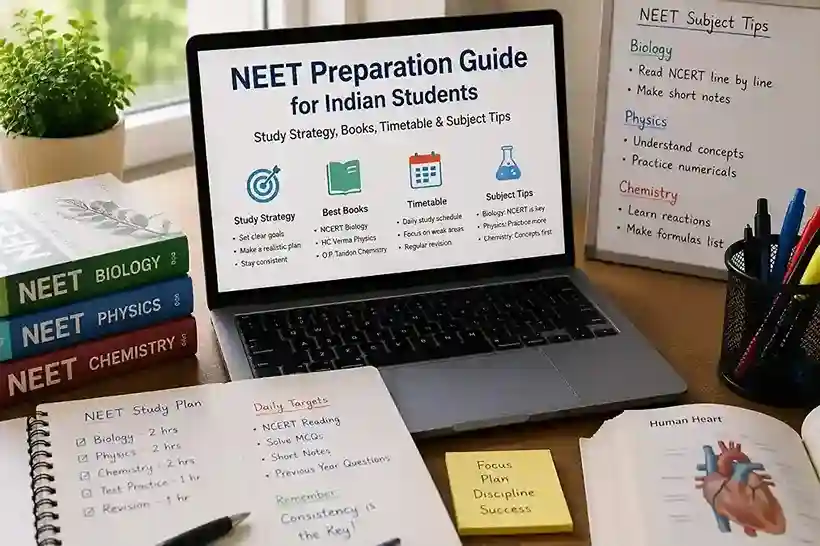
NEET Exam Structure and Marking Scheme
Knowing the exam pattern before you start is essential. NEET has 200 questions in total. You must attempt 180 of them. The total marks are 720. The exam duration is 3 hours and 20 minutes.
Each correct answer gives you 4 marks. Each wrong answer cuts 1 mark. Unattempted questions carry no penalty. This means accuracy matters as much as speed. Never guess blindly, especially in Physics.
| Section | Questions | Attempt | Max Marks | Negative Marking |
|---|---|---|---|---|
| Biology (Botany + Zoology) | 100 | 90 | 360 | -1 per wrong |
| Physics | 50 | 45 | 180 | -1 per wrong |
| Chemistry | 50 | 45 | 180 | -1 per wrong |
| Total | 200 | 180 | 720 |
When to Start NEET Preparation
The earlier you start, the better. Students who begin in Class 11 have the strongest advantage. Starting early gives you time to cover both Class 11 and Class 12 syllabi without rushing.
Students who begin preparation in Class 11 can complete their first pass of the entire syllabus by the end of Class 12 January. This leaves four to five months purely for revision and mock tests before the May exam.
If you are starting from Class 12, begin on Day 1 of the academic year. Prioritise NEET-relevant topics that overlap with your board syllabus. Biology and Chemistry have significant overlap with Class 12 board content. Use that to your advantage.
For NEET 2027 aspirants who are currently in Class 11, June 2026 is the ideal time to start. You have approximately 23 months. Use them well. Read about the complete NEET UG exam details on our exam page before you finalise your plan.
NCERT: The Foundation of NEET
NCERT is not optional for NEET. It is the exam. The official NEET syllabus, prescribed by the National Medical Commission, is based entirely on NCERT Class 11 and 12 textbooks across all three subjects.
Seventy to ninety percent of NEET questions come directly from NCERT content. For Biology, this number is even higher. Questions test specific lines, diagram labels, table footnotes, and boxed examples that most students skip while reading.
What NCERT mastery actually means:
- Read every line of NCERT Biology, including side notes and captions
- Solve all back-exercise questions in Physics and Chemistry NCERT
- Memorise NCERT Chemistry reactions, equations, and named compounds
- Study every NCERT diagram and be able to label it from memory
- Read NCERT Biology at least twice before moving to any reference book
Biology Strategy: 360 Marks That Can Make or Break Your Rank
Biology is the most important subject in NEET. It carries 360 marks | half the paper. Top rankers consistently score 340 to 360 in Biology. This is what separates a rank in the hundreds from a rank in the thousands.
Biology in NEET comes from Botany (Class 11 and 12) and Zoology (Class 11 and 12). Both sections carry equal weightage. You cannot afford to neglect either.
How to study NEET Biology
- Read NCERT Biology line by line, including examples and margin text
- Make short notes with key definitions, diagrams, and classification tables
- Draw and label all diagrams repeatedly: nephron, heart, brain, mitosis, meiosis
- Create flashcards for scientific names, taxonomic classifications, and hormones
- Revise each chapter at least three times before your final exam
- Solve NCERT exemplar questions chapter by chapter
- Practice previous year NEET biology questions (PYQs) for at least 10 years
High-weightage Biology chapters
Some chapters appear in NEET almost every single year. These must receive your deepest attention:
- Genetics and Evolution | Principles of inheritance, molecular basis of inheritance
- Human Physiology | Digestion, circulation, excretion, neural control
- Plant Physiology | Photosynthesis, respiration, plant growth
- Ecology | Ecosystems, biodiversity, population ecology
- Biotechnology | Principles and applications, recombinant DNA technology
- Cell Biology | Cell structure, cell cycle and cell division
- Human Reproduction | Reproductive system, embryonic development
- Animal Kingdom and Plant Kingdom | Classification and characteristics
Physics Strategy: Build Concepts First, Then Solve
Physics is the most difficult subject for most NEET aspirants. It requires both conceptual clarity and numerical practice. Memorising formulas without understanding them leads to errors under exam pressure.
NEET Physics is more conceptual than JEE Physics. You do not need extremely complex derivations. However, you do need a clear understanding of why a formula works, not just what it is.
How to study NEET Physics
- Read NCERT Physics thoroughly for conceptual clarity
- Build a formula sheet for each chapter and revise it weekly
- Solve at least 100 MCQs per chapter from a quality reference book
- Focus on understanding the concept behind each formula
- Do not skip diagram-based questions | they appear frequently
- Solve PYQs chapter-wise; identify which formula types repeat most
High-weightage Physics chapters
- Mechanics | Kinematics, Newton's laws, rotational motion, gravitation (12-13 questions expected)
- Electrostatics and Current Electricity | Coulomb's law, capacitors, Ohm's law
- Optics | Ray optics, lenses, wave optics
- Modern Physics | Photoelectric effect, atomic structure, nuclear physics
- Thermodynamics | Laws of thermodynamics, heat transfer
- Magnetism and Moving Charges | Lorentz force, electromagnetic induction
- Semiconductor Devices | Diodes, transistors, logic gates
Chemistry Strategy: The Scoring Bridge Between Biology and Physics
Chemistry is the subject where most students can gain quick marks. It is more manageable than Physics and more structured than Biology. Many NEET Chemistry questions are direct and NCERT-based.
NEET Chemistry has three parts: Physical Chemistry, Organic Chemistry, and Inorganic Chemistry. Each needs a different study approach.
Physical Chemistry
This section is numerical. You need formula clarity, unit awareness, and regular problem practice. Cover thermodynamics, equilibrium, electrochemistry, mole concept, and solutions from NCERT first. Then practice numericals from a reliable reference book.
Organic Chemistry
Start with General Organic Chemistry (GOC). Understanding reaction mechanisms at this stage makes every other organic topic easier. Memorise all named reactions | these appear directly in NEET every year. Key topics include Haloalkanes, Alcohols, Aldehydes, Ketones, Amines, and Biomolecules.
Inorganic Chemistry
Inorganic Chemistry is almost fully NCERT. Focus on:
- P-block elements | properties, reactions, and uses
- D-block and F-block elements | electron configurations, colour, and oxidation states
- Coordination compounds | IUPAC naming, isomerism, VBT, CFT
- Chemical bonding and periodic properties
Chapter-Wise Weightage for NEET 2026-27
Knowing chapter weightage lets you invest time where it counts most. The data below is based on PYQ analysis across multiple NEET exam years. It helps you identify which chapters to master first.
| Subject | High-Weightage Chapters | Expected Questions |
|---|---|---|
| Biology | Genetics and Evolution | 8–10 |
| Biology | Human Physiology | 8–10 |
| Biology | Ecology and Environment | 12–15 |
| Biology | Biotechnology and Applications | 8–10 |
| Biology | Cell Structure and Cell Division | 6–8 |
| Biology | Human Reproduction | 5–7 |
| Physics | Mechanics (Class 11) | 12–13 |
| Physics | Electrostatics and Current Electricity | 7–9 |
| Physics | Modern Physics | 5–7 |
| Physics | Optics | 5–6 |
| Chemistry | Organic Chemistry (GOC + Reactions) | 8–10 |
| Chemistry | Coordination Compounds | 3–5 |
| Chemistry | P-Block and D-Block Elements | 4–6 |
| Chemistry | Thermodynamics and Equilibrium | 4–5 |
Class 11 contributes approximately 45 to 50% of the NEET paper. Students who neglect Class 11 Physics and Biology consistently underperform regardless of how well they know Class 12 content.
Best Books for NEET 2026-27
The most common mistake aspirants make is collecting too many books. Pick one primary source and one reference per subject. Master those completely. Spreading across five books means shallow knowledge everywhere.
| Subject | Primary (Compulsory) | Reference Book |
|---|---|---|
| Biology | NCERT Biology Class 11 and 12 | Trueman's Objective Biology, MTG Fingertips Biology |
| Physics | NCERT Physics Class 11 and 12 | DC Pandey Objective Physics, HC Verma (selected chapters) |
| Physical Chemistry | NCERT Chemistry Class 11 and 12 | OP Tandon Physical Chemistry |
| Organic Chemistry | NCERT Chemistry Class 11 and 12 | MS Chouhan Organic Chemistry |
| Inorganic Chemistry | NCERT Chemistry Class 11 and 12 | VK Jaiswal Inorganic Chemistry |
| PYQs and Mock Tests | MTG 33-Year NEET Chapterwise PYQs | Arihant NEET Explorer, NTA Official Mock Tests |
For a detailed comparison of medical courses available after NEET, read our Medical Admissions Guide. It covers MBBS seats, AYUSH courses, and cutoff trends.
NEET Daily Study Timetable
A timetable only works if it is realistic. Most NEET students are also managing school or board exam preparation. The timetable below is designed for Class 12 students attending school. Adjust the timings based on your school hours.
| Time Slot | Activity | Duration |
|---|---|---|
| 5:30 AM – 6:30 AM | Biology NCERT revision or flashcard review | 1 hour |
| 6:30 AM – 7:30 AM | Morning routine and school preparation | | |
| 7:30 AM – 2:00 PM | School (pay attention | board prep aids NEET) | | |
| 2:30 PM – 3:15 PM | Post-school rest and light revision | 45 min |
| 3:30 PM – 5:30 PM | Physics: concept study and MCQ practice | 2 hours |
| 5:30 PM – 6:00 PM | Short break | walk, eat, rest eyes | 30 min |
| 6:00 PM – 8:00 PM | Chemistry: NCERT + problem solving | 2 hours |
| 8:30 PM – 10:30 PM | Biology: new chapter or deep chapter revision | 2 hours |
| 10:30 PM – 11:00 PM | Quick recall of today's learning | no new content | 30 min |
| Weekend (Saturday) | Full-length mock test under exam conditions | 3 hrs 20 min |
| Weekend (Sunday) | Detailed mock test analysis and weak-chapter revision | Full day |
Droppers and full-time NEET aspirants should target 8 to 10 hours of focused study daily. Split this as: Biology 4 hours, Physics 2.5 hours, Chemistry 2.5 hours. Adjust based on your personal weak areas.
Month-Wise NEET Preparation Plan (12-Month Roadmap)
A 12-month plan starting in June 2026 is ideal for NEET 2027 aspirants. The plan divides into three clear phases. Each phase builds on the one before it.
Build core concepts from scratch. Follow NCERT strictly for all three subjects. Prioritise Biology and Physical Chemistry since these take the most time to absorb.
- Complete Class 11 Biology NCERT fully by Month 2
- Cover Class 11 Physics chapters with NCERT + concept notes
- Finish Class 11 Chemistry: Physical and some Inorganic chapters
- Begin chapter-wise MCQ practice alongside each chapter
- Do not start mock tests yet | concepts first
Cover the entire Class 12 syllabus. This is your most demanding phase. Maintain consistency and avoid backlogs.
- Complete Class 12 Biology: Genetics, Evolution, Biotechnology, Ecology
- Cover Class 12 Physics: Electrostatics, Current Electricity, Optics, Modern Physics
- Finish Class 12 Chemistry: Organic reactions, Coordination compounds, Electrochemistry
- Start unit-wise mock tests at the end of each unit
- Begin solving chapter-wise PYQs to identify common question patterns
This is where ranks are made. No new topics. Only deep revision, mock tests, and error correction.
- Complete Revision Cycle 1: Full syllabus revision from your notes
- Complete Revision Cycle 2: High-weightage chapters and PYQ re-solving
- Complete Revision Cycle 3: Formula sheets, Biology keywords, rapid recall
- Take 2 to 3 full mock tests per week in the last 2 months
- Maintain an error notebook and review it every 3 days
- No new books or coaching modules in this phase
Mock Test Strategy: How to Use Tests to Actually Improve
Mock tests are not just practice. They are diagnostic tools. Most students write a test, check the score, feel good or bad about it, and move on. This is wrong. The real value of a mock test is in what you learn from your mistakes.
How many mock tests should you take?
In the last 3 months before NEET, aim for at least 30 to 40 full-length mock tests. In the final month, take 2 to 3 per week. Write tests under strict exam conditions: timer on, no phone, no interruptions.
How to analyse a mock test
- After every test, go through every wrong answer without exception
- Write the correct answer and the reason you got it wrong in your error notebook
- Categorise errors: Concept gap, Silly mistake, or Time pressure
- Revisit all concept-gap errors within 48 hours
- Track which chapters produce the most errors each week
- Review your error notebook every 3 to 4 days for repeated patterns
Chapter-wise tests come first. As your preparation progresses, shift to full-length tests. Chapter tests build depth; full-length tests build stamina and time management. Both are necessary.
Revision and Retention: How to Remember What You Study
Without revision, you forget 80% of what you learned within a week. This is not an exaggeration. The human brain does not retain information without repeated exposure. Plan revision cycles from the very beginning.
Effective revision techniques for NEET
- Spaced repetition: Revise a chapter 1 day after, 1 week after, and 1 month after first reading
- Active recall: Close your notes and try to recall key points from memory before checking
- Flashcards: Use for Biology terms, chemical reactions, Physics formulas, and organic reactions
- Concise notes: Write short revision notes after every chapter. Use diagrams and bullet points
- Teaching method: Explain a concept out loud as if teaching someone. Gaps in your explanation reveal gaps in your understanding
The error notebook
Keep a dedicated notebook for every mistake you make in tests or practice. Record the question, the correct answer, and the reason you were wrong. Review this notebook every 3 to 4 days. Repeated errors in this book point to your weak areas. Fix those areas before the exam.
How to Score 650+ in NEET
Scoring 650 and above places you in a strong position for government MBBS seats. Here is a subject-wise breakdown of how to reach that target.
| Subject | Target Score | Key Focus Area |
|---|---|---|
| Biology | 340 – 355 / 360 | NCERT mastery, 3+ revision cycles, diagram practice |
| Chemistry | 150 – 165 / 180 | NCERT Inorganic, named reactions, Physical numericals |
| Physics | 140 – 160 / 180 | Mechanics, Electrostatics, Modern Physics, formula recall |
| Total | 650 – 680 / 720 | 30+ mock tests, error analysis, consistent revision |
Students targeting AIIMS Delhi or top government colleges need 680 or above. For this, Biology must be near perfect, and you need at least 150+ in both Physics and Chemistry.
Check our NEET UG exam page for previous year cutoff marks and category-wise qualifying percentiles.
Tips for NEET Droppers and Repeaters
If you are taking a drop year, you already have a full understanding of the syllabus. That is your biggest advantage. Use it wisely.
- Start with a detailed analysis of where your previous attempt went wrong
- Do not restart from scratch | you know the content; fill the gaps instead
- Focus more on mock tests and revision than on new learning
- Change your daily routine if the previous one did not work
- Set monthly score targets and track progress through regular tests
- Join a dropper batch or crash course only if it adds structure, not just more content
- Manage stress | drop-year pressure is real; take regular short breaks
Most droppers who score 600+ in their repeat attempt do so by spending 70% of their time on revision and mock tests, not re-reading content they already know.