What Is Engineering Admission in India
Engineering admission in India refers to the process of securing a seat in an undergraduate B.E. or B.Tech program. These four-year programs are offered by thousands of colleges across the country. Seats are allotted through entrance exams, state counselling, or direct admission, depending on the type of college.
India has over 5,800 AICTE-approved engineering colleges. The approved B.Tech intake for 2025-26 alone stood at approximately 15.98 lakh seats. Competition varies significantly: IIT seats are among the most contested in the world, while many private colleges offer easier entry through management quota or merit-based direct admission.
Understanding the full picture before you apply is critical. The wrong choice | wrong college, wrong branch, or missed deadline | affects four years of your life and your career start. This guide covers every route, every exam, and every process for Engineering Admissions 2026 in India.
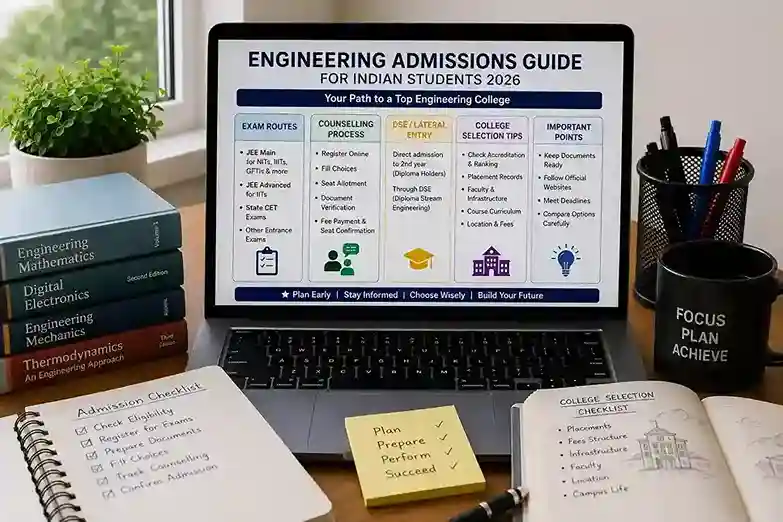
Eligibility Criteria for Engineering Admission 2026
Every engineering college in India requires students to meet a basic set of eligibility conditions. These vary slightly between national exams, state counselling, and private universities. Here is what most colleges require.
Standard eligibility for B.Tech/B.E. admission
- Pass Class 12 (HSC or equivalent) from a recognised board
- Must have Physics, Chemistry, and Mathematics (PCM) as core subjects
- Minimum 50% aggregate marks in PCM (40% for reserved category students in many states)
- For IITs, NITs, IIITs, and GFTIs via JoSAA: minimum 75% in Class 12 overall (65% for SC/ST)
- Age: generally no upper age limit for B.Tech (NTA removed age bar for JEE Main)
Eligibility for DSE (Direct Second Year / Lateral Entry)
- Completion of a 3-year Diploma in Engineering from an AICTE-approved institution
- Minimum 45% marks in the diploma (40% for reserved category students)
- B.Sc graduates with Mathematics as a major subject are also eligible in most states
- D.Voc (3-year) holders in allied sectors are eligible in Maharashtra
Three Main Routes to Engineering Admission in India
Engineering admission in India happens through three distinct pathways. Your path depends on your target college type, entrance exam score, and state of residence.
Appear in JEE Main or JEE Advanced. Use scores for JoSAA counselling to access IITs, NITs, IIITs, and GFTIs. Most competitive. Covers premier government colleges.
Appear in your state's entrance exam (MHT CET, KCET, AP EAMCET, etc.). Participate in state counselling. Gives access to state government and aided colleges.
Appear in BITSAT, VITEEE, SRMJEEE, or other private exams. Or apply directly to private colleges based on Class 12 merit or management quota.
Many students use all three routes simultaneously. Applying to JEE Main, a state CET, and one private exam gives you multiple options without extra preparation | the PCM syllabus overlaps heavily across all of them.
National Entrance Exams: JEE Main and JEE Advanced
JEE Main 2026
JEE Main is conducted by the National Testing Agency (NTA). It is held in two sessions | Session 1 in January and Session 2 in April. Students can appear in both sessions and use their best score.
JEE Main gives access to NITs, IIITs, and GFTIs through JoSAA counselling. It is also the qualifying exam for JEE Advanced. Scores are accepted by many state counselling systems too, including MHT CET CAP rounds, JAC Delhi, and UPTAC.
JEE Advanced 2026
JEE Advanced is the gateway to all 23 Indian Institutes of Technology (IITs) and IISc Bangalore. Only the top 2.5 lakh candidates from JEE Main are eligible to appear for JEE Advanced. Admission to IITs happens exclusively through JEE Advanced ranks via JoSAA counselling.
JEE Advanced 2026 was conducted after JEE Main results. Approximately 18,951 B.Tech seats are available across all 23 IITs. These are among the most sought-after engineering seats in India.
State-Level Engineering Entrance Exams 2026
Each state in India conducts its own engineering entrance exam for admission to government, aided, and private engineering colleges within that state. Here is the state-wise exam summary.
| State | Exam | Conducting Body | Admission Basis |
|---|---|---|---|
| Maharashtra | MHT CET | State CET Cell | MHT CET + JEE Main (optional) |
| Tamil Nadu | TNEA | DoTE, Chennai | Class 12 marks only | no entrance exam |
| Karnataka | KCET | KEA | KCET score + Class 12 marks |
| Andhra Pradesh | AP EAMCET | JNTUA / APSCHE | EAMCET score |
| Telangana | TS EAMCET | JNTUH | EAMCET score |
| Uttar Pradesh | UPTAC via JEE Main | AKTU | JEE Main score |
| West Bengal | WBJEE | WBJEEB | WBJEE score |
| Gujarat | GUJCET | GSEB / ACPC | GUJCET + JEE Main |
| Kerala | KEAM | CEE Kerala | KEAM score + Class 12 marks |
| Bihar | BCECE | BCECE Board | BCECE score |
| Delhi / NCR | JAC Delhi | JAC | JEE Main score |
| Odisha | OJEE | OJEE Board | OJEE or JEE Main score |
Tamil Nadu is unique among all states. TNEA counselling uses only Class 12 board marks. No separate entrance exam is needed. This is managed by the Directorate of Technical Education (DoTE), Chennai, through the TNEA online portal.
Private University Entrance Exams for Engineering 2026
Several top private universities conduct their own entrance exams. These exams run separately from JoSAA and state counselling. They are strong alternatives for students who want quality private colleges without relying only on JEE Main ranks.
| Exam | University / Colleges | Conducted By |
|---|---|---|
| BITSAT | BITS Pilani, Goa, Hyderabad | BITS Pilani |
| VITEEE | VIT Vellore, Chennai, Bhopal, AP | VIT University |
| SRMJEEE | SRM Institute of Science and Technology | SRM IST |
| MET | Manipal University | Manipal Academy of Higher Education |
| KIITEE | KIIT University, Bhubaneswar | KIIT |
| CUET | Central Universities and several private universities | NTA |
| THAPAR FEAT | Thapar Institute of Engineering and Technology | Thapar University |
BITSAT, VITEEE, and SRMJEEE have their own separate counselling processes. They do not participate in JoSAA or state counselling. Students must register and apply to each separately within their application windows.
Many students target VIT, SRM, Manipal, and Thapar as strong private alternatives. Their placement records and industry partnerships make them credible options alongside NITs. Read our NIRF Rankings page to compare top engineering colleges before applying.
JoSAA Counselling 2026: Complete Step-by-Step Process
JoSAA stands for Joint Seat Allocation Authority. It is the central authority that manages seat allocation across IITs, NITs, IIITs, IIEST Shibpur, and Government-Funded Technical Institutes (GFTIs). Any student with a valid JEE Main or JEE Advanced rank must go through JoSAA to secure a seat in these institutes.
JoSAA 2026 registration opened on June 2, 2026. Round 1 seat allotment results were declared on June 13, 2026. The process runs in multiple rounds through July 2026. Vacant seats after JoSAA rounds are managed by the Central Seat Allocation Board (CSAB).
Institutes covered under JoSAA 2026
- 23 Indian Institutes of Technology (IITs) | approximately 18,951 B.Tech seats
- 31 National Institutes of Technology (NITs) | approximately 24,229 B.Tech seats
- 26 Indian Institutes of Information Technology (IIITs)
- 40 Other Government-Funded Technical Institutes (GFTIs)
- IISc Bangalore and IIEST Shibpur
JoSAA counselling process | step by step
Log in using your JEE Main application number and password at josaa.nic.in. Your details are auto-fetched from the NTA database. Verify name, category, gender, and rank before proceeding.
Select your preferred institutes and branches in order of priority. Include reach options (dream colleges), match options (realistic based on rank), and safe options. Use previous year opening and closing ranks to build a smart choice ladder. Lock choices before the deadline | do not rely on last-minute logins.
JoSAA releases two mock allotment rounds before the final Round 1. Use these to check your probable seat, revise your order of choices, and add safer backup options if needed.
After each allotment round, accept your seat online and pay the seat acceptance fee. You must then choose: Freeze (accept and stop), Float (accept but stay in queue for a better seat in later rounds), or Slide (accept but allow upgrade within same institute).
After final seat allotment, visit the designated reporting centre for document verification. Carry all required original documents. Failure to report on time cancels your allotment.
State-Wise Engineering Counselling 2026
Students who do not secure a preferred seat through JoSAA, or who did not appear in JEE Main, can access seats through state-level counselling. Each state runs its own system with its own exam scores, merit lists, and counselling rounds.
Maharashtra: MHT CET CAP Rounds
Maharashtra conducts the Centralised Admission Process (CAP) managed by the State Common Entrance Test Cell. CAP rounds are held for first-year B.Tech seats based on MHT CET scores. JEE Main scores are also accepted by certain participating institutes. Three main CAP rounds are held, followed by institute-level rounds for remaining vacant seats.
Tamil Nadu: TNEA Counselling
Tamil Nadu Engineering Admissions (TNEA) is unique in India. No separate entrance exam is conducted. Admission is based purely on Class 12 marks. The DoTE, Chennai manages online TNEA counselling. Government engineering colleges, aided colleges, and university departments under Anna University and Annamalai University participate in TNEA.
Karnataka: KCET Counselling via KEA
Karnataka Examinations Authority (KEA) conducts KCET counselling for engineering seats in government and aided colleges in Karnataka. KCET scores are the primary basis, combined with Class 12 marks. Institutions like RV College of Engineering, BMS College of Engineering, and SSN College of Engineering participate through their respective state systems.
Other state counselling bodies
- AP EAMCET: Andhra Pradesh | for government and private engineering colleges
- TS EAMCET: Telangana | similar structure to AP EAMCET
- JAC Delhi: For Delhi-NCR institutions using JEE Main scores
- UPTAC: Uttar Pradesh | AKTU-affiliated colleges via JEE Main
- OJEE: Odisha | accepts both OJEE and JEE Main scores
- HSTES: Haryana | for engineering seats in Haryana colleges
- REAP: Rajasthan | for engineering admissions in Rajasthan
For comprehensive college comparison across states, use our Universities directory. Filter by state, ranking, and branch to shortlist colleges before counselling begins.
Direct Second Year Engineering (DSE): What Is Lateral Entry?
Direct Second Year Engineering, commonly called DSE or lateral entry, is a route for diploma holders and B.Sc graduates. It allows eligible candidates to join the second year (third semester) of a B.E. or B.Tech program directly, bypassing the first year entirely.
This means a 3-year diploma holder can complete a full B.Tech degree in just 3 more years instead of 4. The total time from Class 10 to a B.Tech degree through this route is often shorter and more cost-effective than the standard first-year route.
Who is eligible for DSE lateral entry?
- Students who completed a 3-year Diploma in Engineering or Technology from an AICTE-approved institution
- Minimum 45% marks in the diploma overall (40% for reserved category candidates)
- B.Sc graduates with Mathematics as a major subject, who also cleared Engineering Graphics and Engineering Mechanics
- D.Voc (3-year) graduates in allied sectors (state-specific eligibility)
How many seats are available for DSE?
AICTE mandates a 10 percent supernumerary quota in every sanctioned engineering branch for lateral entry candidates. This is over and above the regular first-year intake. Additionally, seats vacated by first-year students can also be filled through DSE rounds. This means DSE students compete for their own dedicated seats.
DSE Admission in Maharashtra 2026: Complete Process
Maharashtra has one of the most structured direct second year engineering admission processes in India. It is managed by the Directorate of Technical Education (DTE) and the State Common Entrance Test Cell. All admissions go through the Centralised Admission Process (CAP).
Key facts about Maharashtra DSE 2026
- No entrance exam required for DSE in Maharashtra | admission is merit-based
- Merit is calculated on final-year (Semester 5 and 6) diploma marks only | NOT the 3-year average
- The State CET Cell prepares the State Merit Number (SMN) based on final-year marks
- E-Scrutiny (online document verification) is mandatory | blurry uploads cause rejection
- DSE registrations typically open in June; CAP Round 1 results usually come in July
- Four CAP rounds are held; institutional-level rounds fill remaining seats in August
DSE CAP process in Maharashtra | step by step
Register at cetcell.mahacet.org once the DSE admission window opens. Pay the non-refundable counselling registration fee. Upload all required documents clearly.
Documents are verified online. Submit diploma mark sheets, diploma certificate, SSC and HSC certificates, category and domicile certificates if applicable. Rejected documents delay your merit number | resubmit immediately if flagged.
After document verification, the CET Cell publishes the DSE merit list. Your rank among all eligible candidates in your category determines your SMN. Higher SMN means better chances in preferred colleges and branches.
Fill your college and branch preferences in order of priority. Include government colleges, autonomous colleges, and private colleges. Use previous-year cut-off merit numbers to estimate realistic choices.
Four CAP rounds are held. Seats are allotted based on your SMN and preferences. Attend each round until you get a preferred seat or confirm admission at your allotted college.
After accepting a seat, pay the college admission fee and report to the allotted institute with all original documents within the specified date. Missing the reporting deadline cancels your allotment without refund.
Branch shifting rules for DSE in Maharashtra
Many diploma students want to switch to a different engineering branch during lateral entry. Maharashtra has specific group-mapping rules:
- Diploma in IT or Computer Engineering: free to shift to B.Tech CSE, AI-ML, Data Science, or IT
- Diploma in Mechanical: can shift to Mechatronics or Automation; generally cannot shift to core CSE in government/autonomous colleges
- Diploma in Electronics: can shift to Electronics and Telecommunication or related branches
- Many private universities (MIT-WPU, Manipal, LPU) allow open branch shifting with bridge courses in Semester 3
DSE Lateral Entry Admission in Tamil Nadu, Karnataka and Other States
The DSE process differs by state. Here is a quick breakdown of lateral entry admission in key states outside Maharashtra.
| State | Exam / Process | Conducting Body | Merit Basis |
|---|---|---|---|
| Maharashtra | DSE CAP | no entrance exam | DTE + CET Cell Maharashtra | Final-year diploma marks (Sem 5 & 6) |
| Tamil Nadu | TNEA Lateral Entry | DoTE Chennai (tnlea.com) | Qualifying exam marks / merit |
| Karnataka | DCET (Diploma CET) | KEA Karnataka | DCET exam score |
| Uttar Pradesh | AKTU Lateral Entry | AKTU | Diploma merit / AKTU LEET |
| Delhi | DTU LEET / IPU CET LE | DTU / IPU | Lateral Entry Entrance Test |
| Punjab | LEET Punjab | Punjab Technical University | LEET score |
| Odisha | OJEE Lateral Entry | OJEE Board | OJEE lateral entry score |
Tamil Nadu TNEA Lateral Entry 2026
The Directorate of Technical Education (DoTE), Tamil Nadu conducts TNEA lateral entry counselling every year. TNEA Lateral Entry 2026 registration opened on June 7, 2026 and closed on July 7, 2026. The rank list for TNEA Lateral Entry 2026 was scheduled for release on July 15, 2026. The process is fully online through tnlea.com. Students complete registration, document upload, certificate verification, choice filling, and seat allotment entirely online.
Karnataka DCET 2026
Karnataka requires diploma holders to appear in the Diploma Common Entrance Test (DCET) conducted by the Karnataka Examinations Authority (KEA). Lateral entry seats are allotted through KEA counselling based on DCET scores. This is different from Maharashtra where no exam is needed.
Documents Required for Engineering Admission 2026
Missing or incorrect documents is the most common reason for admission delays and rejections. Prepare all documents in advance. Keep original copies and at least two sets of photocopies of every document.
Documents for first-year engineering admission (Class 12 route)
- Class 10 mark sheet and passing certificate
- Class 12 mark sheet and passing certificate
- JEE Main or state CET scorecard / rank card
- Seat allotment letter (from JoSAA / state counselling portal)
- Category certificate (OBC / SC / ST / EWS) if applicable | issued by relevant authority
- Domicile or residence certificate (for state quota seats)
- Aadhaar card or government-issued photo ID
- Passport-size photographs (minimum 6 copies, same as uploaded during registration)
- Migration certificate from previous board
- Gap certificate if there is a year gap after Class 12
- Medical fitness certificate (as required by some institutes)
Additional documents for DSE lateral entry admission
- Diploma mark sheets for all semesters
- Diploma passing certificate / convocation certificate
- Institution bonafide certificate from diploma college
- No-objection certificate (NOC) from diploma institution if required
- B.Sc degree certificate and mark sheets (for B.Sc route applicants)
- Gap certificate if any academic year gap between diploma and DSE admission
Government vs Private Engineering Colleges: What to Expect
Choosing between government and private engineering colleges is one of the most important decisions you will make. Both have clear advantages depending on your goals, budget, and rank.
| Factor | Government Engineering Colleges | Private Engineering Colleges |
|---|---|---|
| Annual Fees | Rs. 50,000 to Rs. 2.5 lakh per year | Rs. 1 lakh to Rs. 15 lakh per year |
| Admission Basis | Purely entrance exam rank based | Exam rank, merit, or management quota |
| Infrastructure | Varies; older campuses may be dated | Often modern labs and facilities |
| Faculty | Experienced; often government-appointed | Mix of experienced and younger faculty |
| Placements | Strong at IITs, NITs; moderate at others | Excellent at VIT, BITS, SRM; varies widely |
| Peer Quality | High | students cleared tough entrance exams | Variable | depends on admission cutoffs |
| Research Culture | Strong at IITs and NITs | Growing at BITS, VIT, Manipal |
Top private colleges like BITS Pilani, VIT Vellore, SRM, Manipal, and Thapar consistently produce strong placement outcomes. For students who miss NIT-level ranks, a top private college often delivers better career outcomes than a low-ranking government college in a distant state.
How to Choose the Right Engineering College in 2026
Your college choice shapes your next four years and your early career. A high NIRF rank is not the only factor. Evaluate every college on these practical criteria before confirming admission.
- NIRF Ranking: Check the NIRF 2026 ranking for engineering. Rankings reflect faculty, research, placements, and peer influence
- Branch preference: A strong branch at a lower-ranked college often beats a weak branch at a higher-ranked one. Computer Science, Electronics, and Electrical branches have the strongest placement demand
- Placement data: Ask for actual data: average package, highest package, percentage of students placed, top recruiters. Not just claims on a brochure
- AICTE and NBA accreditation: Ensure the college is AICTE-approved. NBA accreditation for specific programs is an additional quality signal
- Location and industry proximity: Colleges near tech hubs (Bengaluru, Hyderabad, Pune, Chennai, Delhi-NCR) often have better internship and placement access
- Fee affordability: Calculate total 4-year cost including hostel and living expenses. Compare this against placement outcomes realistically
- Faculty and research output: For students planning M.Tech or research careers, faculty quality and publication output matter significantly
Use our Engineering Admissions guide alongside the NIRF Rankings page to shortlist colleges before counselling begins. Also read our JEE Preparation Guide to strengthen your exam score before applying.
Engineering Admission Timeline 2026: Month-by-Month
The engineering admission cycle runs from October to August across two academic years. Missing key dates means waiting another full year. Track every deadline carefully.
JEE Main Session 1 registration opens. Most state CET registrations also open. Apply for JEE Main, MHT CET, KCET, AP EAMCET, BITSAT, VITEEE, and SRMJEEE simultaneously. Do not delay | application windows close quickly.
JEE Main Session 1 conducted (January 21–30, 2026). Results released within 2–3 weeks. Students who want a second attempt can register for Session 2 in February.
JEE Main Session 2 registration. Private university entrance exams (BITSAT, VITEEE) conducted in February to April. KCET, AP EAMCET, MHT CET exam dates announced.
JEE Main Session 2 conducted. State CETs (MHT CET, KCET, AP EAMCET) conducted. JEE Advanced conducted for JEE Main qualifiers. Class 12 board exams concluded.
JEE Main and JEE Advanced results declared. State CET results and rank lists published. VITEEE and SRMJEEE counselling conducted. Class 12 board results declared by most boards.
JoSAA 2026 registration opens (June 2). Choice filling closes (June 11). Round 1 allotment declared (June 13). TNEA counselling begins. DSE Maharashtra registration opens. State CET counselling (MHT CET CAP) registrations begin.
JoSAA rounds 2 to 5 conducted. CSAB special counselling for remaining JoSAA seats. State CET CAP rounds in Maharashtra, Karnataka, Tamil Nadu. DSE Maharashtra CAP Round 1. TNEA lateral entry rank list released (July 15).
Final JoSAA reporting and admission confirmation. Institute-level rounds for vacant seats across all states. DSE Maharashtra final rounds. Last dates for admission across most engineering colleges. Academic year begins.
Related Guides and Resources
- JEE Main and JEE Advanced Preparation Guide
- JoSAA Counselling 2026: Complete Choice Filling Strategy
- JEE Main 2027: Dates, Syllabus, Eligibility and Cutoffs
- NIRF Rankings 2026: Top Engineering Colleges in India
- NEET Preparation Guide for Medical Students
- Scholarships for Engineering Students in India