JEE Preparation Tips: Where to Start
JEE Main is India's gateway exam for engineering admission. NTA conducts it twice a year for entry into NITs, IIITs, and other centrally funded institutes. A strong JEE Main score also qualifies you for JEE Advanced, the exam that leads to IITs.
JEE Main 2027 Session 1 is expected in January 2027. That gives most Class 12 aspirants around seven months from today to build a complete strategy. This guide breaks that time into a clear, week-by-week plan.
These JEE preparation tips work whether you study at a Kota institute, an online platform, or fully alone. Class 11 students get the most value from the full timeline below. Class 12 students, repeaters, and droppers can jump straight to the phase that matches their remaining months.
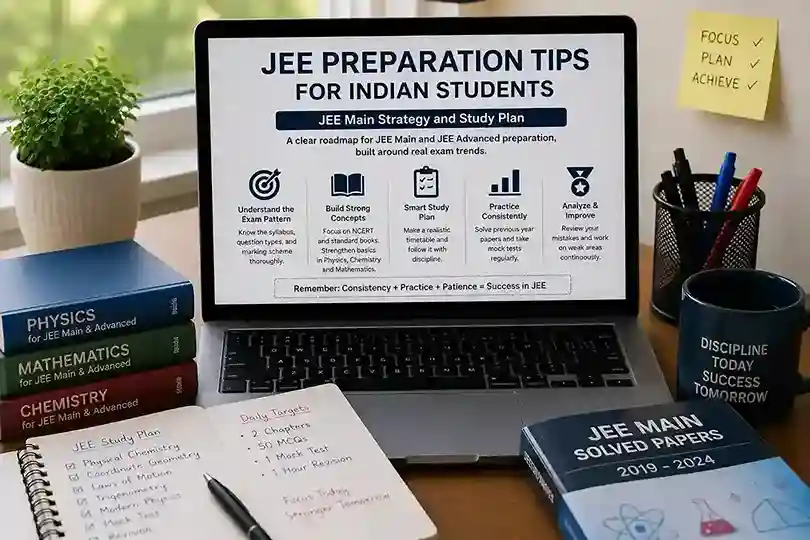
When to Start JEE Preparation
There is no single correct start date. Your ideal plan depends on which class you are in right now.
- Class 9 and 10: Build strong NCERT Science and Maths basics. Skip JEE-specific books for now.
- Class 11: This is the ideal starting point for most students. You get a full two-year runway to cover Class 11 and 12 syllabus together.
- Mid-Class 12 or late starters: Skip exhaustive book reading. Focus only on high-weightage chapters, NCERT, and PYQs.
- Repeaters and droppers: You already know the syllabus. Spend most of your time on mock tests, error analysis, and weak chapters from your previous attempt.
Earlier starts give you more revision cycles. But a focused 6 to 10 month plan can still take a disciplined student to a strong percentile.
JEE Main 2027 Exam Pattern: What Changed
JEE Main Paper 1 has 75 questions for 300 marks. Each subject carries 25 questions: 20 MCQs in Section A and 5 numerical questions in Section B. All 75 questions are compulsory. The exam runs for 3 hours.
Here is the change many students still miss. The official NTA information bulletin confirms negative marking now applies to Section B as well. This is a shift from the older rule, where numerical questions had no penalty. Do not assume numerical questions are risk-free. Attempt them only when you trust your calculation.
The syllabus has stayed mostly unchanged since NTA's 2024 reduction. Past cuts removed topics like Communication Systems, States of Matter, Surface Chemistry, and Mathematical Induction. No major new cuts are expected for 2027. Always confirm against the official syllabus PDF once NTA releases the new bulletin, usually in October or November 2026.
Track every official update on our JEE Main exam page as the 2027 notification approaches.
JEE Main Eligibility: Quick Checklist
Before you plan your strategy, confirm you meet the basic eligibility rules.
- Qualifying exam: Pass Class 12 (or equivalent) with Physics and Mathematics, plus Chemistry, Biology, or a technical vocational subject.
- Passing years: Candidates who passed Class 12 in 2025 or 2026, or who appear in 2027, are eligible.
- Age limit: There is no age limit to appear for JEE Main.
- Attempts: You get two attempts per year, in Session 1 and Session 2.
State-specific engineering colleges may add their own Class 12 percentage criteria later. Check your target college's rule separately from the NTA eligibility rule above.
How to Prepare for JEE Main: Month-by-Month Plan
Phase 1: Foundation (Now – September 2026)
- Complete the remaining Class 11 syllabus across all three subjects
- Read NCERT Physics, Chemistry, and Maths line by line
- Solve NCERT exercises plus exemplar problems chapter by chapter
- Study 6–8 hours daily, split evenly across subjects
- Take one chapter-wise test every week
Phase 2: Advanced Practice (October – December 2026)
- Finish the Class 12 syllabus for all three subjects
- Move to reference books like HC Verma, DC Pandey, and Cengage
- Start 2 full-length mock tests per week
- Maintain an error log for every mistake you make
Phase 3: Revision and Mocks (January 2027)
- Take a full-length mock test daily, matching the real JEE Main pattern
- Revise formulas and reactions every single day
- Solve the last 10 years of PYQs at minimum
- Stop learning new topics two weeks before the exam
After Session 1, use February and March 2027 to fix weak areas before Session 2 in April. Appearing in both sessions only helps your final percentile.
Balancing Board Exams and JEE Main Preparation
Class 12 board exams usually fall between February and March 2027, close to JEE Main Session 1. Many students panic about splitting time between the two.
The good news: JEE Main and board exams share most of the same NCERT base. Strong NCERT preparation for JEE Main also covers 70 to 80% of your board exam syllabus.
- Treat NCERT theory and numericals as common ground for both exams.
- Switch to board-style long-answer practice only 3 to 4 weeks before boards.
- Keep solving JEE-style MCQs and numericals even during board revision, just at a lighter pace.
- Do not abandon JEE practice completely for boards. Short daily revision keeps your speed intact.
Students who integrate both exams from Class 11 onward feel less last-minute pressure. Those who treat the two as separate tracks usually struggle in February and March.
High-Weightage Chapters in Physics, Chemistry, Maths
NTA does not publish official chapter weightage. The patterns below come from analysing past years' question papers. Treat them as a planning guide, not a guarantee.
| Subject | Consistently High-Weightage Chapters |
|---|---|
| Physics | Current Electricity, Electrostatics, Mechanics, Modern Physics, Ray and Wave Optics |
| Chemistry | Coordination Compounds, Thermodynamics, Chemical Bonding, Aldehydes-Ketones-Carboxylic Acids |
| Mathematics | Calculus, Algebra, Coordinate Geometry, Three-Dimensional Geometry |
Within Physics, Mechanics and Electromagnetism together usually form well over half the paper, so secure these chapters first. Within Chemistry, Physical and Organic Chemistry carry more weight than Inorganic, though Inorganic stays scoring and NCERT-based. Within Maths, Calculus alone often contributes close to a quarter of the total marks. This makes it the single highest-priority chapter for most students.
Use this list to set priorities, not to skip chapters entirely. NTA can still ask questions from any topic in the official syllabus.
Best Books for JEE Main and JEE Advanced
Physics
- NCERT Physics (Class 11 and 12), non-negotiable
- HC Verma, Concepts of Physics, Vol 1 and 2
- DC Pandey, Arihant Series, topic-wise
- Irodov, for JEE Advanced-level problems
Chemistry
- NCERT Chemistry (Class 11 and 12), most important book
- OP Tandon, Physical Chemistry
- MS Chouhan, Organic Chemistry
- JD Lee, Inorganic Chemistry
Mathematics
- NCERT Maths (Class 11 and 12)
- RD Sharma, Class 11 and 12
- Cengage Maths Series, topic-wise
- Hall and Knight, for JEE Advanced algebra
Add an Arihant or similar PYQ chapterwise book once your concepts feel solid. Solving real past questions matters more than collecting extra books. Most toppers finish with 4 to 5 books per subject across their full two-year preparation, not 15.
Self-Study vs Coaching: Institutes, Channels, Apps
Coaching is helpful but not mandatory. Many toppers crack JEE Main through self-study alone, supported by free online resources.
If you choose coaching, Kota-based institutes like Allen, Resonance, FIITJEE, and Aakash have a long track record. Narayana and Sri Chaitanya also run large JEE batches across several states. Online platforms like Physics Wallah, Unacademy, and Vedantu offer structured, affordable alternatives for students who cannot relocate.
For free YouTube learning, Physics Wallah's Alakh Pandey covers the full syllabus with a clear, motivational style. Vedantu JEE and Unacademy JEE run live classes and doubt sessions. Physics Galaxy and MathonGo focus deeply on Physics and Maths problem-solving. eSaral and Mohit Tyagi's channel are popular for structured Maths playlists, from basics to advanced.
For apps, start with NTA Abhyas, the official free mock test app from the National Testing Agency. It mirrors the real JEE Main interface closely and should be your benchmark tool. DIKSHA, a government-backed app, is useful for NCERT-based concept revision. Add one trusted coaching app, such as Toppr, only for extra practice. Do not treat any third-party app as your main source of truth.
Whichever path you pick, consistency matters more than the brand name on your notebook. A self-study student with a strict timetable often outperforms a coaching student who skips homework.
How to Prepare for JEE Advanced
JEE Advanced is open only to the top scorers in JEE Main, roughly the top 2.5 lakh candidates. Clearing it opens admission to IITs such as IIT Bombay, IIT Delhi, IIT Kanpur, and IIT Madras. Compare placement and branch data on our NIRF rankings page before you set a target IIT.
JEE Advanced tests the same syllabus as JEE Main, but through harder, multi-step problems. A single question can combine two or three concepts at once.
Start JEE Advanced-level practice only once your JEE Main concepts feel solid. Add Irodov for Physics, Hall and Knight for Algebra, and advanced organic mechanism practice for Chemistry. Solve JEE Advanced PYQs from the last 10 years to learn its question style. This includes multiple-correct options and matrix-match formats.
JEE Advanced registration usually opens within days of the JEE Main Session 2 result. Keep your documents ready in advance if you expect to qualify. The exam itself typically falls in May, leaving only a short window to sharpen advanced problem-solving.
JEE Main vs JEE Advanced Preparation
| Aspect | JEE Main | JEE Advanced |
|---|---|---|
| Question style | Direct, NCERT-based | Multi-step, multi-concept |
| Negative marking | Applies to MCQs and numericals | Varies by question type |
| Best books | NCERT, HC Verma, DC Pandey | Irodov, Hall and Knight, advanced PYQs |
| Who appears | All eligible candidates | Top 2.5 lakh JEE Main rankers |
| Leads to | NITs, IIITs, CFTIs | IITs |
Build your JEE Main base first. JEE Advanced preparation is an extension of that base, not a separate subject.
Daily Routine and Mock Test Strategy
During the main preparation phase, study 6 to 8 focused hours daily, outside school hours. Split this time evenly across Physics, Chemistry, and Maths. Avoid passive reading for hours without solving problems.
Start 2 full-length mock tests per week from Phase 2 onward. Increase this to one mock test daily in the final phase before your exam.
After every mock test, spend time on error analysis. Note whether each mistake came from a concept gap, a calculation slip, or poor time management. Review this log weekly and target your weakest pattern first.
Use previous year questions (PYQs) the right way. Solve them chapter-wise right after finishing that chapter, then again as full mixed sets closer to the exam. PYQs reveal NTA's typical phrasing and trap options, which mock tests built by other platforms cannot always replicate exactly.
JEE Main Final 30 Days: What to Do
- Stop all new topics. Use this time only for revision.
- Take one full-length mock test daily, under real exam timing.
- Revise your formula sheet and error log every single day.
- Re-solve previously wrong questions instead of fresh, unfamiliar ones.
- Protect your sleep, meals, and light exercise. Burnout costs more marks than one extra revision round.
Attempt both Session 1 and Session 2 if you can. Your best score across both counts toward your final percentile.
Exam Day Time Management
You get 3 hours for 75 questions, which works out to about 2.4 minutes per question on average. Plan a rough subject order before you sit for the paper.
- Start with the subject you feel most confident in, to build early momentum.
- Attempt Section A (MCQs) before Section B (numericals) within each subject, since MCQs let you eliminate wrong options.
- Skip a question after 90 seconds of no progress. Mark it and return later if time allows.
- Reserve the last 10 minutes only for review, not for attempting fresh unread questions.
- Since negative marking now applies everywhere, only mark an answer when you are reasonably confident, even in Section B.
Practising this exact sequence during mock tests matters more than practising it for the first time on exam day.
Common Mistakes to Avoid
- Trusting the old negative marking rule: Treating numerical questions as risk-free costs marks under the current pattern.
- Book hoarding: Collecting too many books instead of mastering NCERT and one reference book per subject wastes time.
- Delaying mock tests: Starting full-length mocks only in the last month leaves no room to fix exam temperament.
- Avoiding weak chapters: Skipping topics because they feel boring only guarantees lost marks there later.
- No timetable: Studying without a written plan often turns into directionless revision and lost weeks.
- Comparing paces: Matching a classmate's speed instead of tracking your own error log slows real progress.
- Ignoring sleep and health: Cutting sleep for extra hours usually reduces accuracy more than it adds coverage.
Avoid these traps, and your preparation stays focused on what actually moves your percentile. For the bigger picture after JEE Main, see our engineering admissions guide for counselling and seat allotment steps.
These JEE preparation tips work best when revisited monthly, not read once and forgotten. If you are also weighing medicine as a backup, our NEET preparation guide covers that path in equal detail. For one-on-one guidance on your own timeline, our counsellors offer free sessions through the admissions support page.