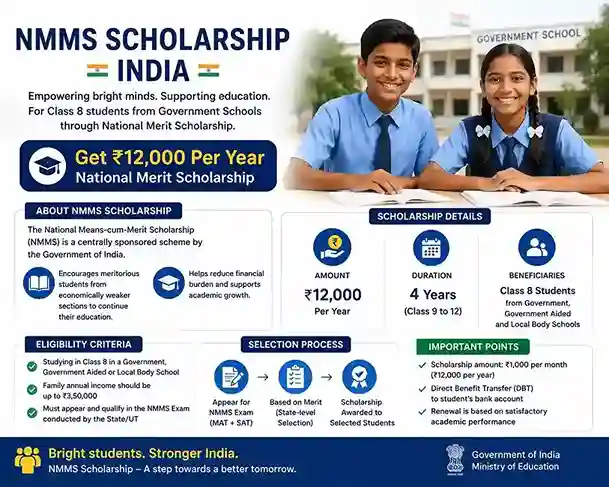
What Is NMMS Scholarship?
The National Means-cum-Merit Scholarship (NMMS) is a central government scheme. The Ministry of Education, Government of India, launched it in 2008. It gives financial support to talented students from low-income families. The goal is simple | stop students from dropping out after Class 8.
Every year, the government awards 1,00,000 scholarships across India. Each selected student gets ₹12,000 per year from Class 9 to Class 12. The money goes directly to the student's bank account each month.
This is not a merit scholarship alone. Students must qualify on both merit and financial need. The family income must be below ₹3.5 lakh per year. This makes NMMS one of the most targeted scholarship programs in India for economically weaker sections.
The scheme runs under the National Scholarship Portal (NSP) at scholarships.gov.in. Each state conducts its own NMMS exam through its SCERT (State Council of Educational Research and Training). Results and merit lists are released state-wise and district-wise.
Who Can Apply | NMMS Eligibility Criteria
Eligibility for NMMS has two parts. First, you need to qualify by income. Second, you need to qualify by academic performance. Here are all the conditions you must meet.
Basic Eligibility Requirements
| Criteria | Requirement | SC/ST Relaxation |
|---|---|---|
| School Type | Government, government-aided, or local body school | Same |
| Class at Time of Exam | Class 8 (regular student) | Same |
| Class 7 Marks | Minimum 55% (or equivalent grade) | 50% minimum |
| Family Income | Below ₹3,50,000 per year from all sources | Same |
| Qualifying Exam Score | 55% aggregate in MAT + SAT | 50% aggregate |
| Class 8 Marks (for scholarship award) | Minimum 55% | 50% |
Who Is NOT Eligible for NMMS?
Some students cannot apply even if they meet the income and marks criteria. This matters because many parents do not know this in advance.
- Students in Kendriya Vidyalayas (KVs)
- Students in Jawahar Navodaya Vidyalayas (JNVs)
- Students in Sainik Schools
- Students in private unaided schools
- Students in state government residential schools where boarding, lodging, and education are all provided
- Students already receiving a scholarship under another Central Government scheme
NMMS Exam Pattern | MAT & SAT Full Details
The NMMS exam is held in offline (pen and paper) mode. It has two separate papers | MAT and SAT. Both are conducted on the same day. Here is everything you need to know about the paper pattern.
Paper 1: Mental Ability Test (MAT)
| Detail | Info |
|---|---|
| Number of Questions | 90 Multiple Choice Questions (MCQs) |
| Total Marks | 90 |
| Time Allowed | 90 minutes |
| Topics Covered | Analogy, classification, numerical series, pattern perception, hidden figures, mirror images, embedded figures, reasoning |
| Negative Marking | None |
| Mode | Offline (OMR sheet) |
Paper 2: Scholastic Aptitude Test (SAT)
| Detail | Info |
|---|---|
| Number of Questions | 90 MCQs |
| Total Marks | 90 |
| Time Allowed | 90 minutes |
| Subjects | Science (Physics, Chemistry, Biology), Social Science (History, Geography, Political Science, Economics), Mathematics |
| Syllabus Level | Class 7 and Class 8 NCERT curriculum |
| Negative Marking | None |
| Mode | Offline (OMR sheet) |
Qualifying Marks
Students must pass both papers. The minimum qualifying threshold is:
- General / OBC candidates: 40% aggregate in MAT and SAT combined (approximately 72 out of 180)
- SC / ST / PwD candidates: 32% aggregate (approximately 58 out of 180)
Clearing the qualifying marks does not guarantee a scholarship. Final selection depends on state quota, category reservation, and district-wise merit ranking. More on this in the selection section below.
Language of the NMMS Exam
States offer the exam in the regional medium of instruction. Most states conduct it in Hindi, English, and the regional language. For example, Maharashtra offers it in Marathi, Urdu, and English. Always confirm the available languages with your school before applying.
State-Wise NMMS Exam Dates 2026-27
Each state runs its own NMMS exam. There is no single national exam date. Most states hold the exam between November and February. The table below shows the exam schedule based on 2025-26 data and expected 2026-27 patterns.
Always confirm dates with your state's SCERT or school board website. These dates are indicative and subject to official notification.
| State / UT | Exam Date (2025-26 Held) | Expected Window (2026-27) | Conducted By |
|---|---|---|---|
| Uttar Pradesh | November 9, 2025 | November 2026 | UP Examination Regulatory Authority |
| Andhra Pradesh | December 7, 2025 | December 2026 | DGE, Andhra Pradesh |
| Maharashtra | December 21, 2025 | December 2026 | MSCE Pune |
| Delhi | December 7, 2025 | December 2026 | SCERT Delhi |
| Gujarat | January 3, 2026 | January 2027 | SEB Gujarat |
| Tamil Nadu | November–December 2025 | November–December 2026 | DGE Tamil Nadu |
| Karnataka | November–December 2025 | November–December 2026 | DSERT Karnataka |
| Bihar | December–January 2025-26 | December–January 2026-27 | SCERT Bihar |
| Rajasthan | November–December 2025 | November–December 2026 | Rajasthan Board / Shala Darpan |
| West Bengal | December 2025 | December 2026 | WBSED |
| Odisha | November–December 2025 | November–December 2026 | TE & SCERT Odisha |
| Telangana | November–December 2025 | November–December 2026 | DGE Telangana |
| Madhya Pradesh | November–December 2025 | November–December 2026 | SCERT MP |
| Kerala | November 2025 | November 2026 | SCERT Kerala |
| Punjab | November–December 2025 | November–December 2026 | SCERT Punjab |
| Haryana | November 2025 | November 2026 | SCERT Haryana |
| Jharkhand | November–December 2025 | November–December 2026 | JAC / SCERT Jharkhand |
| Assam | November–December 2025 | November–December 2026 | SCERT Assam |
| Chhattisgarh | November–December 2025 | November–December 2026 | SCERT Chhattisgarh |
| Uttarakhand | November 2025 | November 2026 | SCERT Uttarakhand |
For states not listed here | Manipur, Mizoram, Goa, Nagaland, Meghalaya, Sikkim, Arunachal Pradesh, and all Union Territories | check the official SCERT or School Education Department website directly. Smaller states typically hold exams in the same November–February window.
How District-Wise NMMS Selection Works
This is one of the most misunderstood parts of NMMS. Many students think passing the exam is enough. It is not. Selection happens at the district level, not just the state level.
District Quota System
Each state's total scholarship quota gets divided among its districts. This distribution is based on the number of eligible Class 7 students enrolled in that district. So a large district with more students gets more scholarship slots.
For example, Odisha has a state quota of 3,314 scholarships spread across its 30 districts. UP had 14,925 selected students across all its districts in 2026. Gujarat has a quota of 5,097 scholarships distributed across its districts.
Within each district, there is further reservation for SC, ST, OBC, and Physically Disabled (PH) candidates. Final merit lists are prepared district-wise and category-wise. The PDF merit list is released with roll numbers and names sorted by district.
What This Means for You
If you are from a large district, you will compete against more students. If you are from a smaller district, the quota may also be smaller. Your rank must fall within the quota for your district and your category to receive the scholarship.
Scoring above the minimum qualifying marks is necessary | but not sufficient. You must also rank within your district's allocation. This is why students from districts with lower enrolment sometimes find it relatively easier to qualify.
How to Check District-Wise Results
NMMS merit lists are released as PDF files. They are available on the official SCERT or state education department website. Each PDF is sorted by district. Follow these steps:
- Visit your state's SCERT or exam authority website
- Go to the Results or NMMS section
- Download the district-wise merit list PDF for your district
- Press Ctrl + F and search for your roll number or name
- If your name appears, you are selected for the scholarship
NMMS State Quota | How Many Scholarships Per State?
India awards 1,00,000 NMMS scholarships every year. These are distributed among all states and Union Territories. The quota for each state depends on Class 7 enrolment in government schools. Here are approximate quotas for major states based on official allocation patterns.
| State | Approx. Scholarship Quota | Notes |
|---|---|---|
| Uttar Pradesh | ~14,925 | Largest state quota in India |
| Maharashtra | ~6,800 | MSCE Pune conducts the exam |
| Madhya Pradesh | ~6,600 | Large rural student base |
| Bihar | ~5,433 | District-wise merit lists released |
| Gujarat | ~5,097 | Conducted by SEB Gujarat |
| Rajasthan | ~5,100 | Shala Darpan portal for results |
| Tamil Nadu | ~4,200 | DGE Tamil Nadu manages |
| Andhra Pradesh | ~3,800 | DGE AP releases district pass rates |
| West Bengal | ~4,000 | Results on wbsed.gov.in |
| Odisha | ~3,314 | 30 districts; SC, ST, SEBC, PH reserved |
| Karnataka | ~3,500 | DSERT Karnataka |
| Telangana | ~2,800 | Results released June 2026 |
| Jharkhand | ~2,200 | JAC manages the exam |
| Assam | ~2,411 | Separate district-wise list |
| Kerala | ~1,900 | SCERT Kerala |
| Punjab | ~1,800 | SCERT Punjab |
| Chhattisgarh | ~2,100 | Large tribal student population |
| Haryana | ~1,700 | SCERT Haryana |
| Uttarakhand | ~1,200 | Results released early |
| Delhi | ~1,400 | SCERT Delhi |
Note: Quota figures are based on official allocations and may vary slightly year to year. Always refer to your state's official SCERT notification for the exact number.
NMMS Scholarship Amount & Benefits
The NMMS scholarship gives a fixed amount directly to the student. There are no intermediaries. The money arrives via Direct Benefit Transfer (DBT) into the student's Aadhaar-linked bank account.
| Component | Amount | Details |
|---|---|---|
| Annual Scholarship | ₹12,000 | ₹1,000 per month |
| Duration | Class 9 to Class 12 | 4 academic years |
| Total Benefit (4 years) | ₹48,000 | Subject to renewal each year |
| Payment Method | Direct Benefit Transfer (DBT) | Aadhaar-linked bank account only |
| Total Scholars/Year | 1,00,000 | Distributed across all states and UTs |
| Budget Allocation | ₹1,827 crore | Approved for 2021-22 to 2025-26 |
The scholarship is not a one-time grant. It renews each year from Class 9 through Class 12. But renewal is not automatic. Students must apply for renewal every year on the NSP portal. They must also meet the academic conditions for continuation.
Documents Required for NMMS Scholarship
Keep these documents ready before you start the online application on NSP. Missing any one can cause rejection or delay in payment.
- 📄 Aadhaar Card | Student's Aadhaar (name must exactly match form)
- 📄 Class 7 Marksheet | To prove minimum 55% marks
- 📄 Class 8 Marksheet | Required at the time of scholarship award
- 📄 NMMS State Exam Scorecard | Official result or selection letter from state
- 📄 School Bonafide Certificate | Signed by the school principal
- 📄 Family Income Certificate | Must show income below ₹3.5 lakh; must be of the current financial year
- 📄 Bank Passbook | In the student's name; Aadhaar-linked; savings account in a nationalized or scheduled bank
- 📄 Caste Certificate | If claiming SC/ST/OBC reservation
- 📄 Disability Certificate | If applicable (PwD students)
- 📄 Passport-Size Photographs | 2 recent photos
How to Apply for NMMS Scholarship | Step by Step
The NMMS process has two stages. First, you appear in the state-level exam. After clearing it, you apply on the NSP portal for scholarship disbursement. Follow these steps carefully.
Stage 1: Apply for the NMMS State Exam
Visit your state's SCERT or School Education Department website. Find the NMMS application link for the current year.
Download or obtain the application form. In many states, this is done through your school. Some states accept online applications directly.
Fill in the form. Attach required documents | Class 7 marks, income certificate, school certificate. Submit before the state deadline.
Collect your admit card from your school or download it from the SCERT portal 10–15 days before the exam.
Appear in the NMMS state exam. Attempt both MAT and SAT papers. Each has 90 questions and lasts 90 minutes.
Stage 2: Apply on NSP After Clearing the Exam
Check your state result. Download the district-wise merit list PDF. Confirm your name and roll number appear in the selected list.
Go to scholarships.gov.in. Click "Apply for One-Time Registration (OTR)". Complete Aadhaar-based KYC to get your unique OTR number.
Log in and click "Apply for Scholarship". Select the NMMS scheme. Fill in all required details. Upload your documents.
Your school principal verifies the application on NSP and forwards it to the state authority for final approval.
Once approved, ₹1,000 per month is transferred to your Aadhaar-linked bank account via DBT. Renew on NSP every year before October 31.
NMMS Selection Process & Merit List
Understanding the full selection process helps you plan better. Here is how a student goes from appearing in the exam to receiving the scholarship amount.
Step-by-Step Selection Flow
Step 1 | State Exam: Students in Class 8 take the MAT and SAT. Results are released between February and June by each state.
Step 2 | Cutoff & Quota Check: The state publishes a district-wise merit list. Only students within the district quota and category reservation slots are selected. There is no single national cutoff.
Step 3 | Class 8 Marks Verification: Selected students must have secured 55% (50% for SC/ST) in their Class 8 annual exam. This is checked before scholarship is finalized.
Step 4 | NSP Application: Selected students register and apply on the National Scholarship Portal. School verification happens here.
Step 5 | PFMS/DBT Registration: Student's bank account is linked through PFMS for Direct Benefit Transfer. Aadhaar seeding is mandatory.
Step 6 | Scholarship Disbursement: Once approved, ₹12,000 per year is credited in monthly installments of ₹1,000.
What Happens If You Miss a Renewal Year?
Missing even one year of renewal ends the scholarship permanently. Failing a class also disqualifies you. The scholarship cannot be restored after discontinuation due to either reason.
NMMS Renewal Rules | Class 10, 11 & 12
Renewal is mandatory every year. The conditions for continuing the scholarship change slightly as you move up classes.
| Class | Condition for Renewal |
|---|---|
| Class 10 | Promoted from Class 9 to Class 10 in the first attempt. Minimum 55% in Class 9 annual exam (50% for SC/ST). |
| Class 11 | Promoted from Class 10 to Class 11. Must score at least 60% in the Class 10 board exam (55% for SC/ST). |
| Class 12 | Promoted from Class 11 to Class 12 in the first attempt. Must maintain required marks and continue in an eligible school. |
Renewal applications open on NSP around June every year. The deadline is generally October 31. Always submit renewal well before the deadline. Late renewal can cause payment gaps that are hard to resolve.
Students must remain enrolled in a government or government-aided school throughout Class 9 to Class 12. Moving to a private or KV school after selection will disqualify you from NMMS even if you continue to qualify academically.
How to Prepare for the NMMS Exam
The NMMS exam is competitive. Over 1.5 lakh students registered in UP alone for 14,925 seats. You need a focused study plan. Here is a practical approach.
For the Mental Ability Test (MAT)
MAT tests your reasoning skills, not your school knowledge. Practice these topic types regularly:
- Analogies (word and figure-based)
- Number series and letter series
- Classification problems
- Pattern perception and completion
- Hidden figures and embedded figures
- Mirror images and spatial reasoning
- Coding and decoding
Use previous years' question papers to understand the question style. There are no textbooks for MAT. Practice is the only way to improve.
For the Scholastic Aptitude Test (SAT)
SAT covers Class 7 and Class 8 NCERT content. Focus on these subjects:
- Science: NCERT Class 7 and 8 | Physics (light, sound, force), Chemistry (atoms, metals), Biology (cells, food, reproduction)
- Social Science: History (medieval and modern India), Geography (resources, agriculture, maps), Political Science (government, democracy), Economics (basic concepts)
- Mathematics: Rational numbers, algebraic expressions, mensuration, data handling, linear equations, triangles, geometry
Key Preparation Tips
- Finish the NCERT Class 7 and 8 syllabus at least one month before the exam
- Solve at least 5 previous year NMMS question papers for your state
- Time yourself | each paper is 90 minutes for 90 questions, so you get 1 minute per question
- There is no negative marking, so attempt all questions
- For MAT, daily 30-minute reasoning practice builds speed and accuracy
Many states release previous year NMMS question papers on the official SCERT website. Download your state's papers. These give the best indication of the actual difficulty level and topic focus.