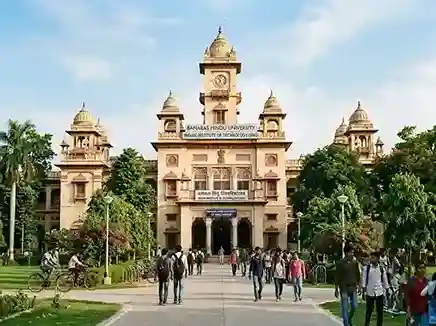
Indian Institute of Technology (Banaras Hindu University) Varanasi | popularly known as IIT BHU or IIT Varanasi | is one of India's oldest and most distinguished technical institutions. With a heritage stretching back to 1919, when it was founded as the Banaras Engineering College (BENCO) within the sprawling Banaras Hindu University campus, IIT BHU carries more than a century of engineering excellence. It officially attained the coveted Indian Institute of Technology designation in 2012 under the Ministry of Education, Government of India, elevating it to an Institute of National Importance.
Located in Lanka, Varanasi, Uttar Pradesh, IIT BHU is situated on one of India's largest engineering university campuses, spanning approximately 1,300 acres within the BHU complex. This fully residential campus uniquely blends a rich historical legacy with modern academic and research infrastructure, offering students a distinctive academic environment that few institutions in India can match. The campus is served by the Pt. Deen Dayal Upadhyaya Junction railway station and Lal Bahadur Shastri International Airport, both easily accessible from the campus.
As of 2026, IIT BHU holds the NIRF Engineering Rank #10 | placing it firmly among the top 10 engineering institutes in India. The institute also holds NIRF Rank #31 Overall and NIRF Rank #22 in Research Institutions. Globally, IIT BHU is ranked #566 in QS World University Rankings 2026, with a strong 45.2 score in Citations per Faculty | reflecting the depth of its research output. It has been accredited by NAAC with Grade A, and holds approvals from UGC and AICTE.
What sets IIT BHU apart from virtually all other IITs is its extraordinary institutional depth. While most IITs were established in the 1950s–2010s, IIT BHU traces its engineering education lineage to 1919 | over 100 years of shaping Indian engineers and technologists. The Banaras Engineering College (1919) evolved into the Institute of Technology-BHU (IT-BHU) in 1968, when the colleges of Engineering, Mining & Metallurgy, and Technology merged. The formal IIT designation in 2012 recognised decades of academic distinction and research excellence.
The institute runs 17 academic units comprising 10 engineering departments, 3 science departments, 3 interdisciplinary schools, and 1 humanities & social sciences school. The faculty strength stands at approximately 300 faculty members, with a total student population exceeding 9,300 | among the largest of all IITs. The student-faculty ratio is approximately 20:1, supporting both large-scale research output and individual mentorship.
IIT BHU has seen a remarkable ascent in national rankings: climbing from 15th in NIRF Engineering 2023 to 10th in NIRF Engineering 2024 and 2026, demonstrating sustained institutional improvement across teaching, research, graduation outcomes, outreach, and perception. The institute's perception score of 98/100 in NIRF 2026 reflects its outstanding reputation among peers, employers, and the broader academic community.
Varanasi, one of the world's oldest continuously inhabited cities, provides IIT BHU with a unique cultural and intellectual setting. The institute's 1,300-acre campus within BHU is a self-contained academic ecosystem with hostels, research centres, hospitals, sports facilities, and cultural venues. Varanasi is well connected by rail (Varanasi Junction, Pt. Deen Dayal Upadhyaya Junction) and air (Lal Bahadur Shastri International Airport), making it accessible from all major Indian cities. The city's growing industry, IT sector, and startup ecosystem increasingly attract IIT BHU alumni back to the region.
IIT BHU has climbed impressively in national and global rankings, cementing its position as one of India's top 10 engineering institutions. Here is a complete ranking snapshot.
| Ranking Body | Category | Rank / Score | Year | Change |
|---|---|---|---|---|
| NIRF | Engineering | 10 | 2026 | ▲ Up from #15 in 2023 |
| NIRF | Overall | 31 | 2026 | ▲ Stable |
| NIRF | Research Institutions | 22 | 2026 | Stable |
| QS World | World Universities | #566 | 2026 | Score 29.3 |
| NIRF Score | Engineering Perception | 98/100 | 2026 | Near Perfect |
| NAAC | Accreditation Grade | Grade A | – | – |
| The Week | B.Tech | 9 | 2023 | Strong |
IIT BHU's NIRF Engineering Rank #10 places it in elite company | ahead of several older and newer IITs. Its perception score of 98/100 in NIRF 2026 is one of the highest among all IITs, reflecting how strongly it is regarded by recruiters, academicians, and peer institutions. The QS World Rank of #566 and a Citations per Faculty score of 45.2 confirm the international visibility of its research output.
IIT BHU offers a rich portfolio of undergraduate, postgraduate, and doctoral programmes across engineering, science, architecture, and pharmaceutical sciences | spanning 17 academic units.
One of the most competitive B.Tech branches at IIT BHU. Strong placement record with an average of ₹34.87 LPA and a JEE Advanced closing rank of ~1,350.
Covers VLSI, signal processing, communication systems, and embedded systems. One of the highest-demand branches with consistently strong JEE Advanced cutoffs.
Strong core engineering department with specialisations in manufacturing, thermal systems, robotics, and design. Active in core sector placements including Tata Steel and BHEL.
Covers structural engineering, geotechnics, transportation, environmental engineering, and water resources. Graduates placed in infrastructure, consulting, and UPSC roles.
A unique interdisciplinary programme combining advanced mathematics, statistics, and computing. Highly popular with aspirants due to strong tech placements.
Strong ties with petrochemical, pharmaceutical, and process industries. Active research in reaction engineering, transport phenomena, and materials processing.
One of IIT BHU's historically strong departments. Covers extractive metallurgy, materials characterisation, and process metallurgy with strong industry linkages.
Unique to IIT BHU among all IITs | a full B.Tech and M.Pharm programme in Pharmaceutical Engineering, reflecting Varanasi's pharmaceutical industry ecosystem.
A 5-year B.Arch programme. Admission via JEE Advanced + Architecture Aptitude Test (AAT). Covers design studio, urban planning, history of architecture, and building technology.
IIT BHU offers a wide range of postgraduate programmes. M.Tech admissions are through a valid GATE score, followed by counselling via GATE-COAP. M.Sc programmes (Chemistry, Physics, Mathematics, Applied Geophysics) are offered via IIT JAM. The M.Pharm programme in Pharmaceutical Engineering is distinct to IIT BHU among all IITs. PhD admissions are conducted twice a year (July and December) across all departments, with candidates required to hold a Master's degree or a B.Tech with excellent academic credentials and GATE/NET/JEST qualification.
IIT BHU has consistently delivered outstanding placement results. The 2026–27 season saw record participation from 330+ companies and a landmark ₹2.2 Crore highest package | offered to 17 students.
| Metric | Data |
|---|---|
| Highest Domestic Package | ₹2.2 Crore PA |
| Students at Highest Package | 17 Students |
| Overall Average Package | ₹22.56 LPA |
| CSE Average Package | ₹34.87 LPA |
| Overall Placement Rate | 92.33% |
| Total Companies Participated | 330+ |
| Pre-Placement Offers (PPOs) | 297 PPOs |
| Total Job Offers | 1,000+ |
Over 330 national and international companies participated in IIT BHU placements 2026–27. The recruiter base spans technology, finance, consulting, core engineering, and pharmaceuticals.
IIT BHU cutoffs are among the most competitive of all IITs. CSE closing rank under 1,400 (General category) places it in the top tier of JEE Advanced aspirants' choices.
| Year | CSE Closing Rank (GN) | Electronics Engg. (GN) | Math & Computing (GN) | Arch. (GN) |
|---|---|---|---|---|
| 2026 | ~1,350 | ~2,300 | ~1,900 | ~19,019 |
| 2024 | ~1,015 | ~2,100 | ~1,700 | ~18,500 |
| 2023 | ~1,200 | ~2,400 | ~1,800 | ~17,800 |
| 2022 | ~1,100 | ~2,200 | ~1,700 | ~16,500 |
Note: Cutoffs are last-round (Round 6) closing ranks from JoSAA. Actual cutoffs vary by year, paper difficulty, and seat matrix. Always refer to official JoSAA data at josaa.admissions.nic.in. JEE Advanced 2026 results are expected June 1, 2026.
IIT BHU's B.Tech fee structure is among the most affordable of all IITs. SC/ST/PwD students receive full tuition fee waivers, and multiple scholarship schemes are available for meritorious students.
| Fee Component | Amount Per Semester | Annual Amount | Notes |
|---|---|---|---|
| Tuition Fee | ~₹1,00,000 | ~₹2,00,000 | Same for all B.Tech branches |
| Examination Fee | ~₹1,500 | ~₹3,000 | – |
| Registration & Other Fee | ~₹10,000–₹15,000 | ~₹20,000–₹30,000 | Varies by year |
| Hostel Seat Charges | ₹12,000–₹15,000 | ₹24,000–₹30,000 | Excluding mess |
| Mess Charges (approx.) | ~₹20,000–₹25,000 | ~₹40,000–₹50,000 | Varies by mess/season |
| Total 4-Year B.Tech Fee | ₹8.47 Lakh (approx.) | Including all components | |
IIT BHU holds NIRF Research Rank #22 and a QS Citations per Faculty score of 45.2, reflecting a vibrant and internationally recognised research culture spanning engineering, science, and interdisciplinary frontiers.
Century-old heritage in metals and materials research. World-class labs including Transmission Electron Microscopes, X-ray diffraction facilities, and advanced alloy synthesis units.
Growing cluster of AI/ML research in the CS department, with faculty publishing in top-tier venues such as NeurIPS, ICML, and CVPR. Strong interaction with industry labs.
Unique to IIT BHU among IITs | active research in drug delivery, nanomedicine, pharmaceutical process engineering, and pharmacological studies in collaboration with CSIR labs.
Strong interdisciplinary research in power systems, VLSI design, embedded systems, and smart grid technologies, aligned with India's national priorities in energy and electronics manufacturing.
Active research in Ganga river ecology, wastewater treatment, groundwater remediation, and environmental pollution control | directly relevant to Varanasi's Ganga geography.
Research partnerships with universities in the US, UK, Germany, Japan, and Australia. Ongoing MoUs facilitate faculty exchange, joint PhDs, and sponsored research projects.
Set within the historic 1,300-acre BHU campus in Varanasi, IIT BHU offers a fully residential, self-contained academic township combining heritage buildings with modern research infrastructure.
Technex is the annual technical and cultural festival of IIT BHU | one of the oldest college fests in India, dating back to 1952. It attracts thousands of students from across India for technical events, robotics competitions, hackathons, workshops, guest lectures, and cultural performances. Technex is a major event in the IIT calendar, with sponsorship from leading companies and a national profile that reflects IIT BHU's stature in the Indian academic community.
IIT BHU admission for B.Tech is strictly through JEE Advanced rank via JoSAA counselling. There are no management quota or lateral entry seats.
Qualify JEE Main (Session 1 or 2) and meet the eligibility for JEE Advanced. Top ~2.5 lakh rankers qualify.
Register and appear for JEE Advanced 2026. Results expected June 1, 2026. IIT BHU CSE needs a rank below ~1,500.
Register on josaa.nic.in after JEE Advanced results. Fill choices in order of preference. 6 rounds of seat allotment.
Accept allotted seat, pay partial acceptance fee online, and report to IIT BHU campus with original documents in July 2026.
The most commonly asked questions about IIT BHU Varanasi admission, ranking, fees, placements, and campus life | answered with updated 2026–27 data.
Compare NIRF rankings, fees, placement records, and admission criteria across India's best technical institutions.